Elizabeth I Quotes
Her highness doth charge and command, all manner of her subjects, as well those that be called to ministry in the Church as all others, that they do forbear to preach, or teach, or to give audience to any manner of doctrine or preaching other than to the Gospels and Epistles, commonly called the Gospel and Epistle of the day, and to the Ten Commandments in the vulgar tongue, without exposition or addition of any manner, sense, or meaning to be applied and added; or to use any other manner of public prayer, rite, or ceremony in the Church, but that which is already used and by law received; or the common Litany used at this present in her majesty's own chapel, and the Lord's Prayer, and the Creed in English; until consultation may be had by Parliament, by her majesty and her three estates of this realm, for the better conciliation and accord of such causes, as at this present are moved in matters and ceremonies of religion.
It is this proclamation and others like it that caused many of the American Founding Fathers to include the doctrine of separation of church and state. In this case, and many others, the government actually proscribed and controlled the prayers and the liturgy. See {617532} where the government proscribes the proportion of revenues that must be spent on the poor.
Elizabeth I, 1533-1603, Queen of England, Proclamation to Forbid Preaching, 1558
Sourced by: Eigen's Political and Historical Quotations

In this particular injunction the Queen actually proscribes the amount of church revenues that MUST be distributed to the poor. See {617526} where actual prayers are proscribed by the government.

Carroll was writing to Troy during the time of the question of Catholic emancipation in England. Here he is clearly alluding to the British form of government. Carroll never missed the opportunity to champion religious freedom as manifested in the U.S. Constitution. For an earlier example of his praise for religious freedom, see {596933}.

He was the only English Pope. This was the authority that enabled English King Henry II to invade Ireland. Many historians consider it the beginning of the problems between the Ireland and England which persists to this day. See {610520}. Some scholars think that this bull was a forgery stating that the writing style was different from other bulls of Adrian IV. Opponents believe that a change in secretaries could easily have accounted for the difference.

This is a particularly interesting historical quotation because it succinctly gives a history of the various horrors of religious strife in British history—a history that was very well known to the American Founding Fathers and the general American Colonial population. This history was the major driver behind the public insistence for the Bill of Rights and the 1st Amendment which erected a wall of separation between church and state with government never favoring or abetting any particular religion.

Jorge Mario Bergoglio. This quotation was reprinted in religious and secular organs of almost all religions as the message was universal and could apply also to non-Roman Catholic Churches and non-Christian religions. The Pope in this statement did not change church doctrine one bit. It urged a major change in tactics, context, emphasis and style. Extreme fundamentalists within the Roman Catholic church and without, however, saw the statement as a softening of the moral position of the church regarding these controversial areas. Most however welcomed his quotation as long overdue and a stylistic throwback to a different time where people were less educated and less informed by media.


In 1996 the Tennessee Senate passed a resolution to post the Ten Commandments in homes, schools and businesses. Cohen was then a Senator of the Tennessee State Legislature.

1st Earl of Beaconsfield

1st Baron Macaulay

He was the only English Pope. The act of invasion had been sanctified earlier in Adrian’s Papal Bull. See {610518}. Henry’s invasion was successful but the occupation and reform was a disaster which has ramifications to this day.

Barrow tried to argue that attacking the Bishops was not an attack on the Queen (Elizabeth I) who was head of the church. His argument failed and he was hanged. Even in modern times there are some who see an attack on a cabinet member as an attack on the President or Prime Minister, since the former serve at the suffrage of the latter.

In addition to being a Roman Catholic priest, Father Coughlin was an outspoken radio commentator who was well known for his controversial political opinions, see {598783}, {598784}.


1st Viscount Bolingbroke. This is the argument that was and still is given by most theocracies and nations opposed to pluralism. It was also a quotation which with the American founders were familiar and were targeting this view when they demanded the 1st Amendment.
In some countries, although not theocracies, the religious establishment had an automatic right to sit in the parliament. In this particular case it was essentially only the majority church. Catholics had 1 seat and the various protestant denominations, Jews, and others had no automatic religious representation in the legislature.

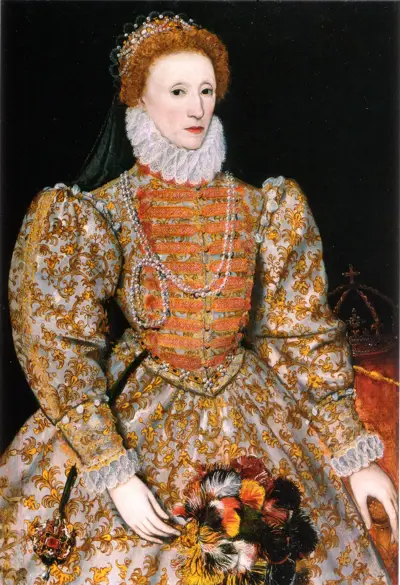
- Born: September 7, 1533
- Died: March 24, 1603
- Nationality: English
- Profession: Royalty
Elizabeth I was Queen of England and Ireland from 17 November 1558 until her death in 1603. Sometimes called the Virgin Queen, Gloriana or Good Queen Bess, Elizabeth was the last of the five monarchs of the House of Tudor.
