John Whitgift Quotes
That none be permitted to preach, or interpret the Scriptures, unless he be a priest, or deacon at the least, admitted thereunto according to the laws of this realm
John Whitgift, 1530?–1604, English Archbishop of Canterbury, Articles Touching Preachers and Other Orders for the Church, 1583
Sourced by: Eigen's Political and Historical Quotations

i.e., a clergyman representing a congregation The theory of this particular expulsion applied not to clergy in general, but to clergy who represented a Congregation. In the absence of strict separation of church and state, clergy representing congregations had representative and legal roles in other aspects of the government and therefore represented a problem of separation of powers within the government. The same logic, for example prohibited Sheriffs and Tax Officials from the House of Commons as well as Judges sitting in the Lords. With strict separation of church and state however, the separation of powers argument does not hold, and hence there is no such current prohibition. However, at the end of the 20th century, the Roman Catholic and some other religious institutions had reached the conclusion that clerics serving as elected representatives to various civil legislative bodies potentially had an inherent conflict of interest and divided loyalty and banned the practice from the religious end although the civil laws did not preclude it.


This notice of Excommunication was promulgated to the Catholic clergy in Ireland in May of 1538. It required all Roman Catholic leaders to size the property of Protestants or Catholics who sympathized with them. Those who did were then regarded as traitors by the Protestant King. The anti-Protestant feeling culminated with the massacre of about 100 Protestants who were drowned in Bann a few years later.


This concept is not terribly different from the concept of the theocracy of the Islamic government of Iran in the 21st century. There is a civil government but it serves and is “under the direction of the spiritual power.”

Carroll was writing to Troy during the time of the question of Catholic emancipation in England. Here he is clearly alluding to the British form of government. Carroll never missed the opportunity to champion religious freedom as manifested in the U.S. Constitution. For an earlier example of his praise for religious freedom, see {596933}.


The letter was written at the behest of the Archbishop of Canterbury. The quotation appears to ratify the Pope’s unlimited power, but in actuality carves out an exception whereby the Pope’s authority might be challenged in the future. Specifically, it claims the Pope has not the authority to alter that which “by the word of God, has eternal validity.” Politically, this position put the pope in a box. By arguing against the proposition, the Pope would have to maintain that he should have the right to alter the word of God that had eternal validity which no pope wanted to state. By not challenging the doctrine, there was an opening by which the pope’s omnipotence could be challenged in the future.
William the Conqueror. This is one of the earliest government action separating some church functions from state functions.

This quotation illustrates how the power and mechanism of an established church operated to control ideas and maintain theological monopoly. In this case, no one could sell or rent any facility in the city to a cleric or church of any kind or persuasion without first having the approval of the Bishop who had theological control of that territory. Even Catholic scholars could not rent a room in the city unless their scholarship met with the Bishop’s approval. This was history with which the American Founding were very familiar, and wanted to avoid by adopting the 1st Amendment.


This was before the state had officially sanctioned and accepted the church. Most of the institutions were pagan and the kings had subjects of both religions with Christianity not yet dominant. Yet among Christians, the Church had government temporal power, even before the church was allied with the state.

The clergy of the colonies were split on the American Revolution, but those clergy who supported the revolution made a huge contribution to the individual American’s intellectual view of the legitimacy of Parliament’s making laws governing the American Colonies. The anti-British clerics called for action while other forces of colonial America urged caution.

Although a conservative, he had a great tolerance for and understanding of other points of view. For this some people thought him a radical.

King Henry VIII had left the Roman Catholic church and taken England and Ireland out also. He replaced the Pope as the head of the English and Irish churches. There was much opposition in Ireland and the priests were the most assertive opponents to the change and were still loyal to the Pope. Queen Elizabeth continued to have problems with the Priests. James I, Elizabeth’s successor, became fed up by the Roman Catholic Priests and therefor issued this Proclamation.


The Torah, the first 5 Books of the Bible, are the statement of Jewish law. The Talmud is a compendium of commentary on Jewish Law—–reflecting the views of a number of learned Rabbis of old. In a sense, they are much like legal opinions from many different judges. They are disparate views and often contradict on another. Few if any other religions, have an official document like it. Other religions key documents are prescriptive, and where there are occasional contradictions , effort is made to rationalize. However Judaism has the strong religious tradition of dissent from singular dogma. Different Jewish sects and groups differ in what in the Talmud they follow, and Reform Jews, the largest group in America, assume a continuing discussion of the Talmud with the ancient Rabbis having no more weight in their opinions that modern thinkers—–theologians, philosophers, and others.
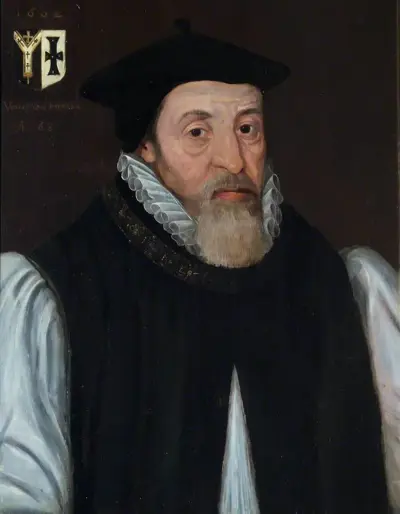
John Whitgift was the Archbishop of Canterbury from 1583 to his death. Noted for his hospitality, he was somewhat ostentatious in his habits, sometimes visiting Canterbury and other towns attended by a retinue of 800 horses. Whitgift's theological views were often controversial.
