Henry II Quotes
It is not permitted the archbishops, bishops, and priests of the kingdom to leave the kingdom without the lord king's permission.
Henry II, 1133-1189, King of England, Constitutions of Clarendon, 1164
Sourced by: Eigen's Political and Historical Quotations

The council was not only fearful of Protestant preaching, but hereby granted a local monopoly within the Catholic Church to the local Bishop.


Some politicians then and later were not as religious as the leading clerics would prefer. The quotation shows that priests commonly married at that time even though the church had forbidden it.


Carroll was writing to Troy during the time of the question of Catholic emancipation in England. Here he is clearly alluding to the British form of government. Carroll never missed the opportunity to champion religious freedom as manifested in the U.S. Constitution. For an earlier example of his praise for religious freedom, see {596933}.

William the Conqueror. This is one of the earliest government action separating some church functions from state functions.

A priest, friar or monk with this commission could and did, remove from the custody and control of the local judges, bailiffs and law enforcement officers clerics who had run afoul of the law. At the time the word “clerk” meant any churchman. The principle at the time was that the state could not judge or dispense justice or punishment to members of the church. Only the church could try and convict clerics and they did that persiant to cannon (religious) law. In theory, the bearer of this commission would take custody of an accused criminal who was a churchman, and bring him to the Bishop who would handle the case under Ecclesiastical Law. Often that meant, doing nothing or minor penitence for a crime that could even bring the death penalty under civil law. Historically there has been a major struggle in the West between the churches and civil governments that still goes on to this day in countries like Ireland. In America, the early 21st century saw the Roman Catholic bishops covering up crimes of sexual predation on the part of Priests. Many people were also outraged that the bishops did not report the Priests to the police, but this was unfortunately a throwback to this historical notion that the Church only can deal with the discipline and legal matters involving church personnel or property. Historically, reporting matters like this to civil authorities for handling is only about 200 years old, while the system illustrated by this quotation had been in place for about 1200 years before.

Note that in addition to getting rid of the authority of the King, New York—over a decade before the Bill of Rights and the First Amendment, provided for a ban on an established church or favoring one Christian sect over another. Even then New York was a multi religious and multi ethnic society with its strong Dutch tradition along with the English tradition. New York did not go as far as the First Amendment would do later in terms of freedom of religion. NY only mentioned Christian sects. However they did implement separation of church and state and an establishment clause. See {621429} for another clause that ensures separation of church and state.

Prior to that there was no redress any layperson had except to the religious courts. Churches throughout the Christian world excoriated this early separation between church and state, and giving civil courts jurisdiction over the churches on non-religious matters. Thomas Beckett led the English opposition to the enforcement.

King Henry VIII had left the Roman Catholic church and taken England and Ireland out also. He replaced the Pope as the head of the English and Irish churches. There was much opposition in Ireland and the priests were the most assertive opponents to the change and were still loyal to the Pope. Queen Elizabeth continued to have problems with the Priests. James I, Elizabeth’s successor, became fed up by the Roman Catholic Priests and therefor issued this Proclamation.

Although James’ mother, Mary Queen of Scots had been a Catholic, James was a fervent Protestant. However, he found the separation of the State from authority over the church and the Presbyterian approach not to his liking. Also, the early tradition of the Presbyterian preachers scolding the monarch, especially his mother, was uncomfortable for James.


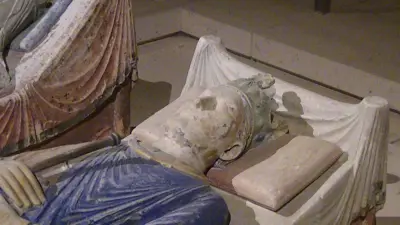
Henry II, also known as Henry Curtmantle (French: Court-manteau), Henry FitzEmpress or Henry Plantagenet, was King of England from 1154 until his death in 1189. He was the first king of the House of Plantagenet. King Louis VII of France made him Duke of Normandy in 1150. Henry became Count of Anjou and Maine upon the death of his father, Count Geoffrey V, in 1151. His marriage in 1152 to Eleanor of Aquitaine, whose marriage to Louis VII had recently been annulled, made him Duke of Aquitaine. He became Count of Nantes by treaty in 1185. Before he was 40 he controlled England, large parts of Wales, the eastern half of Ireland and the western half of France; an area that was later called the Angevin Empire. At various times, Henry also partially controlled Scotland, Wales and the Duchy of Brittany.
