Henry II Quotes
All pleas between clergymen and laymen shall be tried in the king's court .… All clergymen, when accused of any crime, shall be tried in the king's courts …. All prelates, who hold baronies of the king, shall perform the same services with other barons.
Prior to that there was no redress any layperson had except to the religious courts. Churches throughout the Christian world excoriated this early separation between church and state, and giving civil courts jurisdiction over the churches on non-religious matters. Thomas Beckett led the English opposition to the enforcement.
Henry II, 1133-1189, King of England, Constitutions of Clarendon, 1164
Sourced by: Eigen's Political and Historical Quotations

The Supreme Court limited authority of religious courts to matters where both parties belonged to the religion. Jewish courts had tried to assert the power to annul mixed marriages where only one party was Jewish on the grounds that orthodox Jews oppose mixed marriage. Conflict between religious & civil courts has existed ever since there have been civil courts. Historically there was no separation & the Religious Courts in ancient Israel, early Christendom & Islam had universal jurisdiction. As Europe’s civil authorities wrested authority from religious courts, modernity has diminished or eliminated the legal jurisdiction of religious courts. Even in the United States there are courts operated by some religions; if members wish to voluntarily submit their disputes, they can. In most Islamic countries & Israel there are religious courts which have some authority over family & purely religious matters & in Muslim theocracies the religious courts are the only courts as in ancient times.

William the Conqueror. This is one of the earliest government action separating some church functions from state functions.

Note that in addition to getting rid of the authority of the King, New York—over a decade before the Bill of Rights and the First Amendment, provided for a ban on an established church or favoring one Christian sect over another. Even then New York was a multi religious and multi ethnic society with its strong Dutch tradition along with the English tradition. New York did not go as far as the First Amendment would do later in terms of freedom of religion. NY only mentioned Christian sects. However they did implement separation of church and state and an establishment clause. See {621429} for another clause that ensures separation of church and state.


This is a remarkable quotation. Here was a leading minister of the Established Church of England who is arguing that there should be no established church insofar as religious belief is concerned. Essentially this is what England has developed. The Anglican Church is still the established church but only for purposes of state cerimonies and the religion of the Royal Family. The establishment has nothing to do with lawmaking, or common religious belief or inhibition of the many other religions in England and there is complete freedom of conscience.

Sealed under duress and later repudiated by the King with Papal assistance. Prior to Magna Carta, anyone with a civil suit had to take his case to the King's court which moved about as the King traveled. This set the precedent of a fixed court for a jurisdiction, something we totally take for granted today." John Lackland

This is one of the earliest expressions of the first regarding freedom of religion. Note that there was concern about the possible government negative effects on religion as well as the other way around. The Continental Congress was very disparate & often inconsistent. Four months after this passed, the Continental Congress voted to have & pay Christian Protestant Chaplains for the army despite a critical shortage of funds. Further they ordered Washington to require the troops to attend Christian religious services which the General did. After this statement, many Protestant clergy objected. Congress actually depended on the clergy to communicate with the public & prepared many open letters which the asked the clergy to read from the pulpit—especially ones recruiting troops. With the Revolution going badly, the Congress & Washington did not want a dispute with the clergy many of whom were already being pressured against the revolution by their religious superiors in England.


Backus was the first of the American clerics to espouse the position that in order for there to be a Christian nation, the state must be separate from the Church.
Carroll was writing to Troy during the time of the question of Catholic emancipation in England. Here he is clearly alluding to the British form of government. Carroll never missed the opportunity to champion religious freedom as manifested in the U.S. Constitution. For an earlier example of his praise for religious freedom, see {596933}.

Pen name: Jack Nipps

It is this proclamation and others like it that caused many of the American Founding Fathers to include the doctrine of separation of church and state. In this case, and many others, the government actually proscribed and controlled the prayers and the liturgy. See {617532} where the government proscribes the proportion of revenues that must be spent on the poor.

A priest, friar or monk with this commission could and did, remove from the custody and control of the local judges, bailiffs and law enforcement officers clerics who had run afoul of the law. At the time the word “clerk” meant any churchman. The principle at the time was that the state could not judge or dispense justice or punishment to members of the church. Only the church could try and convict clerics and they did that persiant to cannon (religious) law. In theory, the bearer of this commission would take custody of an accused criminal who was a churchman, and bring him to the Bishop who would handle the case under Ecclesiastical Law. Often that meant, doing nothing or minor penitence for a crime that could even bring the death penalty under civil law. Historically there has been a major struggle in the West between the churches and civil governments that still goes on to this day in countries like Ireland. In America, the early 21st century saw the Roman Catholic bishops covering up crimes of sexual predation on the part of Priests. Many people were also outraged that the bishops did not report the Priests to the police, but this was unfortunately a throwback to this historical notion that the Church only can deal with the discipline and legal matters involving church personnel or property. Historically, reporting matters like this to civil authorities for handling is only about 200 years old, while the system illustrated by this quotation had been in place for about 1200 years before.

Madison was a deist, but was firm that religion was to be an individual matter and not an area in which the state ought be involced.


Ingersoll was considered to be the greatest orator and political thinker of his day, but his overt atheistic views curtailed his elected political career.

The Irish monks were loyal to the pope and were outraged when he was displaced by King Henry VIII. They were seen as a hotbed of disloyalty and therefore ordered to close. This is one of the many examples where an established government church dictated not only how people should worship but also prohibit other religions from functioning. These examples were well known to the American Founding Fathers and much of educated American opinion which was one of the drivers of the First Amendment and the separation of church and state.
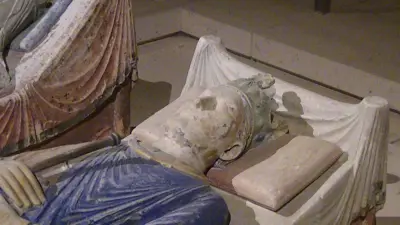
Henry II, also known as Henry Curtmantle (French: Court-manteau), Henry FitzEmpress or Henry Plantagenet, was King of England from 1154 until his death in 1189. He was the first king of the House of Plantagenet. King Louis VII of France made him Duke of Normandy in 1150. Henry became Count of Anjou and Maine upon the death of his father, Count Geoffrey V, in 1151. His marriage in 1152 to Eleanor of Aquitaine, whose marriage to Louis VII had recently been annulled, made him Duke of Aquitaine. He became Count of Nantes by treaty in 1185. Before he was 40 he controlled England, large parts of Wales, the eastern half of Ireland and the western half of France; an area that was later called the Angevin Empire. At various times, Henry also partially controlled Scotland, Wales and the Duchy of Brittany.
