Matthew Hale Quotes
Christianity is part of the Common Law of England.
Matthew Hale, 1609-1676, Chief Justice of England, Historia Placitorum Coronae
Sourced by: Eigen's Political and Historical Quotations

Then, as now, there were some who claimed there should be a larger role for Christianity in American law and governance. One such view in the first half of the 19th century was that whatever was unspecified in the Constitution deferred to the common law. England had an official state Christian church and therefore Christianity must have been a part of English common law and hence should be a significant part of American law and governance. Jefferson was one of the many leaders who refuted the notion by pointing out that the common law in England predated Christianity.

See Matthew Hale for a concurring view and Thomas Jefferson for a contrasting one.


William the Conqueror. This is one of the earliest government action separating some church functions from state functions.


Arguing against the relationship between Christianity and the common law as had been asserted by some English Jurists (see Matthew Hale and James Mansfield)

This was before the state had officially sanctioned and accepted the church. Most of the institutions were pagan and the kings had subjects of both religions with Christianity not yet dominant. Yet among Christians, the Church had government temporal power, even before the church was allied with the state.

There were those who disagreed with Sekulow, especially those whose religions did not recognize the Ten Commandments. Others see the Ten Commandments not in a religious sense but in a cultural sense and therefore the display in the Supreme Court—along with other world historical scenes of laws and lawgiving—was a historical and cultural display which did not help to “establish” any religion.
Jefferson’s concern over issues of church state separation and independence was expressed early when he was a young lawyer.

This is an excellent statement of one of the fundamental principles of many Christian Religious Philosophers.

_0_thumbnail_47x47.jpg "Statue of Robert Hall in Leicester.")
Many of the founding fathers were aware of such views in England as the same issues were being debated in America in the debates on Ratification of the Constitution and the required inclusion of the Bill or Rights—specifically the First Amendment.


Of all the Western Colonial Powers, Spain was the worst. They took the most from their possessions and contributed the least. Worst, they killed off almost all the indigenous people.


Some of the “originalist” judges like Antonin Scalia believe that the “straightjacket” was what was intended by the originators of the Constitution and this was a good thing.

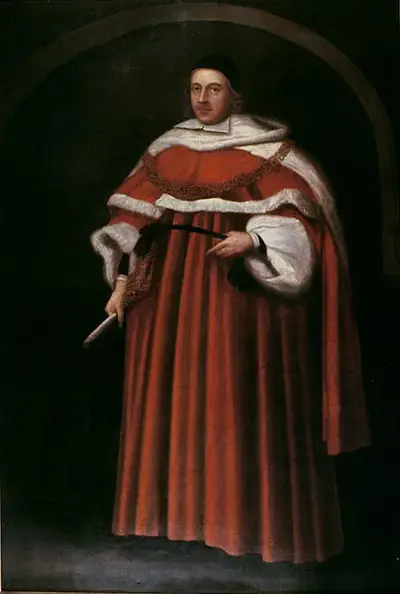
Sir Matthew Hale SL was an influential English barrister, judge and jurist most noted for his treatise Historia Placitorum Coronæ, or The History of the Pleas of the Crown. Born to a barrister and his wife, who had both died by the time he was 5, Hale was raised by his father's relative, a strict Puritan, and inherited his faith. In 1626 he matriculated at Magdalen Hall, Oxford (now Hertford College), intending to become a priest, but after a series of distractions was persuaded to become a barrister like his father thanks to an encounter with a Serjeant-at-Law in a dispute over his estate. On 8 November 1628 he joined Lincoln's Inn, where he was called to the Bar on 17 May 1636. As a barrister, Hale represented a variety of Royalist figures during the prelude and duration of the English Civil War, including Thomas Wentworth and William Laud; it has been hypothesised that Hale was to represent Charles I at his state trial, and conceived the defence Charles used. Despite the Royalist loss, Hale's reputation for integrity and his political neutrality saved him from any repercussions, and under the Commonwealth of England he was made Chairman of the Hale Commission, which investigated law reform. Following the Commission's dissolution, Oliver Cromwell made him a Justice of the Common Pleas.
