Henry III Quotes
It will not be legal for the … citizens to give, sell, or mortgage any burgage or tenement that they hold or shall hold in the same city to a church or to a religious person without the license and consent of the aforesaid bishop and his successors.
This quotation illustrates how the power and mechanism of an established church operated to control ideas and maintain theological monopoly. In this case, no one could sell or rent any facility in the city to a cleric or church of any kind or persuasion without first having the approval of the Bishop who had theological control of that territory. Even Catholic scholars could not rent a room in the city unless their scholarship met with the Bishop’s approval. This was history with which the American Founding were very familiar, and wanted to avoid by adopting the 1st Amendment.
Henry III, 1207-1272, King of England, Edict authorizing the establishing a new city of New Sarum, January 30, 1227
Sourced by: Eigen's Political and Historical Quotations


This was before the state had officially sanctioned and accepted the church. Most of the institutions were pagan and the kings had subjects of both religions with Christianity not yet dominant. Yet among Christians, the Church had government temporal power, even before the church was allied with the state.


As enlightened as this statement is, it was not always a part of Mormon doctrine. When Brigham Young was head of the church he also served as Governor of the Utah Territory, and the separation of church and state was not so clear. In modern times however, the Mormon views have been the quintessential views of most Americans—Mormon or otherwise.

Carroll was writing to Troy during the time of the question of Catholic emancipation in England. Here he is clearly alluding to the British form of government. Carroll never missed the opportunity to champion religious freedom as manifested in the U.S. Constitution. For an earlier example of his praise for religious freedom, see {596933}.


Gregory the Great. “Emoluments” included the income from all lands and other church property, gifts and tithes, and income of any sort. This formula characterized the division of resources for the better part of Christian history. By today’s standard, the proportion for these Bishops (there were those who chose poverty) and his household seems astoundingly high—his income and sustenance was the equal of all the priests in the bishopric. It illustrates the affluence of the bishops who were major forces in their territories. One of the rationales for such an affluent bishop (the assets were not all personal but he had control of them) was that he should be at least the equal of any in the area including kings and nobles for he was to have as much influence as they. It is difficult today to look at modern bishops and realize how their role, power, relative wealth, and influence has changed. Bishops had their own armies, judiciary, accountants, attorneys and were a government unto themselves.

i.e., a clergyman representing a congregation The theory of this particular expulsion applied not to clergy in general, but to clergy who represented a Congregation. In the absence of strict separation of church and state, clergy representing congregations had representative and legal roles in other aspects of the government and therefore represented a problem of separation of powers within the government. The same logic, for example prohibited Sheriffs and Tax Officials from the House of Commons as well as Judges sitting in the Lords. With strict separation of church and state however, the separation of powers argument does not hold, and hence there is no such current prohibition. However, at the end of the 20th century, the Roman Catholic and some other religious institutions had reached the conclusion that clerics serving as elected representatives to various civil legislative bodies potentially had an inherent conflict of interest and divided loyalty and banned the practice from the religious end although the civil laws did not preclude it.


The council was not only fearful of Protestant preaching, but hereby granted a local monopoly within the Catholic Church to the local Bishop.


This notice of Excommunication was promulgated to the Catholic clergy in Ireland in May of 1538. It required all Roman Catholic leaders to size the property of Protestants or Catholics who sympathized with them. Those who did were then regarded as traitors by the Protestant King. The anti-Protestant feeling culminated with the massacre of about 100 Protestants who were drowned in Bann a few years later.
William the Conqueror. This is one of the earliest government action separating some church functions from state functions.

A priest, friar or monk with this commission could and did, remove from the custody and control of the local judges, bailiffs and law enforcement officers clerics who had run afoul of the law. At the time the word “clerk” meant any churchman. The principle at the time was that the state could not judge or dispense justice or punishment to members of the church. Only the church could try and convict clerics and they did that persiant to cannon (religious) law. In theory, the bearer of this commission would take custody of an accused criminal who was a churchman, and bring him to the Bishop who would handle the case under Ecclesiastical Law. Often that meant, doing nothing or minor penitence for a crime that could even bring the death penalty under civil law. Historically there has been a major struggle in the West between the churches and civil governments that still goes on to this day in countries like Ireland. In America, the early 21st century saw the Roman Catholic bishops covering up crimes of sexual predation on the part of Priests. Many people were also outraged that the bishops did not report the Priests to the police, but this was unfortunately a throwback to this historical notion that the Church only can deal with the discipline and legal matters involving church personnel or property. Historically, reporting matters like this to civil authorities for handling is only about 200 years old, while the system illustrated by this quotation had been in place for about 1200 years before.

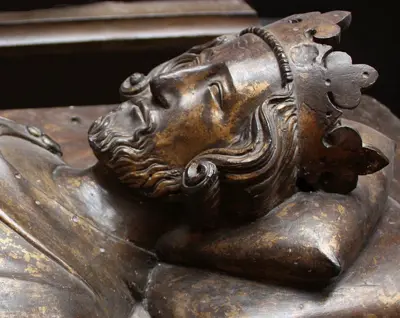
Henry III, also known as Henry of Winchester, was King of England, Lord of Ireland, and Duke of Aquitaine from 1216 until his death in 1272. The son of King John and Isabella of Angoulême, Henry assumed the throne when he was only nine in the middle of the First Barons' War. Cardinal Guala declared the war against the rebel barons to be a religious crusade and Henry's forces, led by William Marshal, defeated the rebels at the battles of Lincoln and Sandwich in 1217. Henry promised to abide by the Great Charter of 1225 (aka Magna Carta), which limited royal power and protected the rights of the major barons. His early rule was dominated first by Hubert de Burgh and then Peter des Roches, who re-established royal authority after the war. In 1230, the King attempted to reconquer the provinces of France that had once belonged to his father, but the invasion was a debacle. A revolt led by William Marshal's son, Richard Marshal, broke out in 1232, ending in a peace settlement negotiated by the Church.
