Philaret Drozdov Quotes
Whereas the Vatican is not only a religious center but also a state, and whereas relations with it have also a political nature, as is evident from the visit of the Pope to the United Nations, one must reckon with the possibility of an influence in some sense of the godless authorities in the matter of the Church of Rome. History testifies to the fact that negotiations with the heterodox under pressure of political factors never brought the Church anything but confusion and schisms.
Vasily Drosdov Philaret, ~1782-1867, Russian Orthodox Metropolitan of New York, President of the Synod of Bishops of the Russian Orthodox Church Outside of Russia, A Protest to Patriarch Athenagoras, December 1965
Sourced by: Eigen's Political and Historical Quotations

In addition to being a Roman Catholic priest, Father Coughlin was an outspoken radio commentator who was well known for his controversial political opinions, see {598783}, {598784}.


Smith was the first Roman Catholic to run for President. He was very popular but there was a substantial amount of anti-Catholicism in America at the time. He lost, probably by the margin of the anti-Catholic vote.


The struggle in the Catholic Church reached an amazing state. Just after a new pope, Martin V, had been elected the Council of Bishops at Constance came up with this notion which placed their views above those of the Pope under the theory that this particular council derived its power and authority directly from Christ while the pope was only God’s “vicar on earth.” The struggle was somewhat akin to the inevitable struggle for power between an executive branch and a legislative branch. The Council’s ascendancy didn’t last very long and was repudiated by successive popes.

Also known as Ferdinand II or Aragon. We have provided an extensive quotation from the letter. In retrospect, it is incredulous today that Ferdinand would make such demands or even would believe that the Indians would understand the terms or their consequences, the threats. Even the promises that are made were ignored because of the Indian’s “intransigence.”


Though Leo XIII was very much opposed to slavery, his claim that the Catholic Church “from the beginning” sought to end slavery overlooks the inconsistent reality of several of his predecessors’ teachings. For an example of this inconsistency one may find a relevant example as late as the 19th century, see the teachings of Gregory XVI {611428}, Pius IX {612304}, and Leo XIII {611844}

The Roman Catholic Church in America had a very difficult problem with slavery. Catholics were themselves a minoirty, hated and distrusted by many Protestants. In most of the country, the distrusr was based on their large immigrant population, but in the South Catholic theology was hated and the Vatican and Pope were particular targets. The Catholic Clergy generally did not want to take sides in the most contentious issue in America since its inception. The Southern Catholic Clergy did not have that option as in the South, anyone who was not a supporter of slavery was an "enemy of the community and subject to all kinds of violence." Some Southern priests were willing to take the personal risk but did not want to put their followers at risk. In a strange consequence, Catholics--especially Irish Catholics--fought on both sides of the Civil War and often against each other. While it was not an exemplary moral behavior for the Church, there were difficult pressures on Catholic leaders. Further, most of the lowest and most difficult, undesirable jobs were filled by Catholics and most Catholic laymen so and end to slavery as the start of pitting the Catholics against the Blacks. So there was not a groundswell for abolition in most Catholic parishes even in the North.

when the encyclical Casti Connubii was promulgated This was written before he was elected Pope. At the time there was some movement within the Catholic Church towards the possible liberalization of the traditional prohibition against birth control of any kind. At the time Montini was in the minority on the Commission, and after he assumed the Papacy, he became a majority of one.


Vasilii Ivanovich Belavin. head of the church. Because he was responsible for the Russian Orthodox Church in North America he developed the complementary title of ‘Enlightener Of America’
Condoms and other birth control usage had been forbidden by the Catholic Church. However, most American Catholics utilized artificial birth control devices anyway. However, the official church positions inhibited and influenced politicians throughout the nations. Even as late as 1963 selling birth control devices was illegal in parts of America. A pharmacist was sentenced to jail for filling a prescription for a condom for a couple where the woman could not bear a child safely as the result of a physical condition. The Supreme Court reversed the conviction.
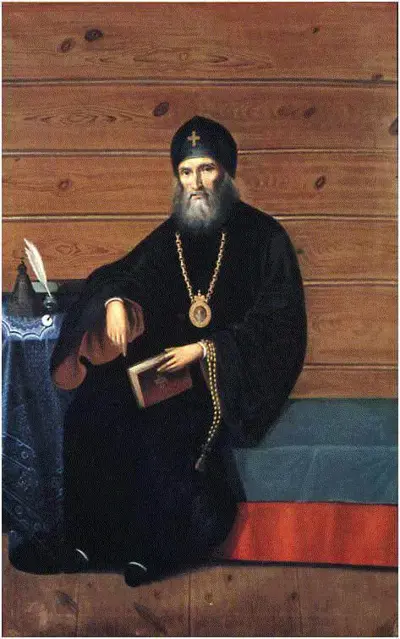
Metropolitan Philaret was Metropolitan of Moscow and Kolomna and the most influential figure in the Russian Orthodox Church for more than 40 years, from 1821 to 1867.
