Leo XIII Quotes
When it is said that the Church is hostile to modern political regimes and that she repudiates the discoveries of modern research, the charge is a ridiculous and groundless calumny. Wild opinions she does repudiate and seditious projects she does condemn.
Leo XIII, 1810-1903, Roman Catholic Pope, Immortale Dei, November 1, 1885
Sourced by: Eigen's Political and Historical Quotations


At the time Islam was quite conflicted about the role of innovation, science and reform. Innovators were to many theologians as dangerous to society as heretics and had to be refuted. Al-Ashari’s school of thought has prevailed in much of the Muslim world to this day.

The Archbishop’s reference to globalization stemmed from his belief that the Government’s desire to participate in multinational trade led them to adopt policies from the majority of other industrial democracies such as no official national religious identification.

Ingersoll was considered to be the greatest orator and political thinker of his day, but his overt atheistic views curtailed his elected political career.

There are some who question the authenticity of this Bull. However, its existence was supported by John of Salisbury who claimed to be the emissary who arranged the Bull. See {611696}. However, those who are shocked that the Pope could have been so crass as to “give” a country to Henry II for money have claimed that the writing of John was also a forgery,

The struggle in the Catholic Church reached an amazing state. Just after a new pope, Martin V, had been elected the Council of Bishops at Constance came up with this notion which placed their views above those of the Pope under the theory that this particular council derived its power and authority directly from Christ while the pope was only God’s “vicar on earth.” The struggle was somewhat akin to the inevitable struggle for power between an executive branch and a legislative branch. The Council’s ascendancy didn’t last very long and was repudiated by successive popes.

In addition to being a Roman Catholic priest, Father Coughlin was an outspoken radio commentator who was well known for his controversial political opinions, see {598783}, {598784}.
The Priest witnessed the complete obliteration of Guernica by bombing and strafing although there were no military targets in the city. The fire in the church had been put out, and it was the only building left standing. Franco, having won the civil war gave the church many powers and was lauded throughout Spanish churches despite the atrocities which were at first denied by the Nationalists and then rationalized later. Guernica was the first city ever completely destroyed by aerial bombardment. The atrocity inspired Picasso’s great painting of that name.

Smith was the first Roman Catholic to run for President. He was very popular but there was a substantial amount of anti-Catholicism in America at the time. He lost, probably by the margin of the anti-Catholic vote.
Vasilii Ivanovich Belavin. head of the church. Because he was responsible for the Russian Orthodox Church in North America he developed the complementary title of ‘Enlightener Of America’


In 1877 Wasburn was dropped from the List of Ministers by the Unitarian Church. He had become very critical of organized and orthodox religion of all kinds.

This is a classic example of institutional reluctance to examine history in the light and morality of the present. Nations have difficulties coming to grips with their pasts just as Churches and other institutions do.


The Vatican & the Chinese Communist Government had been at odds for years with much of the Chinese church going underground. Fr. Jin had been jailed for a decade. Then the government allowed him and the Catholic Church and operate openly, but there were still Vatican conflicts over numerous issues including the right of the Government to approve senior appointments of church officials—a privilege the church claimed exclusively. The Vatican ordered Jin not to cooperate and especially not to reopen the national theological seminary which the government had ordered closed. There had been no training for Chinese priests and Jin wanted to reopen the national theological seminary but the Vatican refused cooperation waiting for the government to capitulate to the Vatican’s various demands. Fr. Jin defied the Vatican & reopened the seminary. Without officially admitting their failed tactics, the Vatican let the discipline issue against Jin drop & the national theological seminary thrived.


While this was his opinion, it was never issued in a Papal Bull or had the force of Catholic law. Meanwhile, almost all of the socialist movements in the West have had Catholics in their leadership and many democrats of modern times would have been considered socialist. Many countries with high proportions of Catholic voters have elected socialist governments in secluding Spain and Italy.

While Perez describes the situation accurately, he does not mention here that there is a minority of fundamentalist Jewish Israelis, and they too do not make compromises easily. Nor do the Christian fundamentalists in the United States. All say, “How do you compromise with the will of God.”
Cyprian was the leader of the Christian Church in Africa. His non-authoritarian style was a radical departure from then civil and religious organizational style. Jews had moved back and forth between Congregational and authoritarian religious organization before, Cyprian’s democratic approach was short lived as the Catholic Church structure evolved emulating, and contesting with, civil authoritarianism. Cyprian’s approach presaged the Christian Congregational development that became the basis of most early American Christian churches.

This view is typical of most religiously educated Muslims and accounts in large part for the fact that the Islamic world is so scientifically backward—especially in the context of the great Islamic scientific development around 1000 AD. Religiously Islam closed and so did the entire outlook of the people, and the existing religious norm accounts for most of the backwardness of Islamic lands.

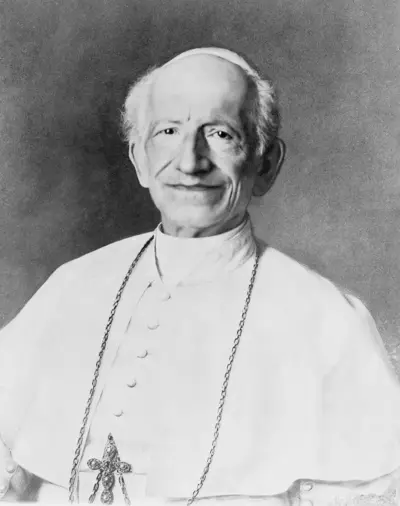
Pope Leo XIII was the head of the Catholic Church from 20 February 1878 to his death in 1903. He was the oldest pope (reigning until the age of 93), with the exception of Pope Benedict XVI as emeritus pope, and had the third-longest confirmed pontificate, behind those of Pius IX (his immediate predecessor) and John Paul II.
