Muhammad Abduh Quotes
The sciences which we feel in need of is thought of by some people to be technology and other means of mastering agriculture and trade. This is false, for if we look at what we complain of, we find something deeper than the mere lack of technology and similar disciplines...The science which will revive the souls is the science of disciplining the soul. Such a discipline exists only in religion, therefore what we lack is extensive knowledge of the ethics of religion and what we need in accordance with our feelings is to have a true understanding of religion.
This view is typical of most religiously educated Muslims and accounts in large part for the fact that the Islamic world is so scientifically backward—especially in the context of the great Islamic scientific development around 1000 AD. Religiously Islam closed and so did the entire outlook of the people, and the existing religious norm accounts for most of the backwardness of Islamic lands.
Muhammad Abduh, 1849-190 Muhammad Egyptian jurist, historian, political scientist, religious scholar and liberal reformer, Mufti of the Egyptian Realm, Editor and Chief of al-Waqāʾiʿ al-Miṣriyya (The Egyptian State Newspaper), Known as “The founder of Islamic Modernism”, Quoted in Views from Muslim Scholars, http://scholar-views.blogspot.com/2007/05/muhammad-abduh-1849-1905.html
Sourced by: Eigen's Political and Historical Quotations

Public money had traditionally been spent to support shrines of Muslim saints. Ataturk ended such subsidies.

Ataturk as part of his radical reforms elevated secular teachers to a very high social status and moved science and engineering into the curriculum over the objections of traditionalists and Islamic fundamentalists, and he did this in an overwhelmingly Muslim country.
This is a very Jeffersonian type statement.

"Innovator" in this sense refers to one who innovates within Islam—who tries to change or reform the religion departing from the original,literal, message of the Prophet. This concept which was embedded into Islamic culture, became one of the intellectual barriers to scientific and technological development of literal islamists.

At the time Islam was quite conflicted about the role of innovation, science and reform. Innovators were to many theologians as dangerous to society as heretics and had to be refuted. Al-Ashari’s school of thought has prevailed in much of the Muslim world to this day.
This was written when Islam was intellectually far more advanced than Christian Europe. This viewpoint was one of the reasons for their advanced civilization. It was held by many. It is still held by many Muslims, but for the fundamentalist of Islam today, ignorance of anything that is not in the Koran or other sayings of the Prophet is a virtue. Madrassas throughout the Islamic world teach only the Koran and religious law and nothing of mathematics, philosophy, science, history and never of other religions.

Islamic modernists like Serageldin are many among the educated Muslims but their views are often drowned out by the violence and extremist statements of the fundamentalists. Ironically, the necessary intellectual freedom existed in the Islamic world one thousand years ago and Islamic science and other learning was as advanced as any and superior to most including the Christians.

Historically, this is an amazing quotation. It is typical of analyses of Islam in the 21st century when America and most of the non-Muslim world was having great difficulties with Islamic militancy. But this was written at the end of the 19th century, in 1899. Churchill had a grasp of much that it would take other politicians a century to understand. This book was relatively unknown to all but a few historians, military men, and political scholars. (There was a shortened version published in 1902 which did not include this passage and that is the version that Project Gutenberg posted on the Internet. So do not assume that the quotation is wrong if you cannot find it in the version you are reading on the Internet. You need the 1899 longer and more detailed version.


While critics of Islam cite this sura to show how absurd the Koran can be and contradicts what is known about the Earth’s orbit, few sophisticated, moderate Muslims believe this. However, even in the United States there are many Christians and Orthodox Jews who not only deny Evolution but also believe the Earth is 6000 years old. The basic difference is that in Islamic countries publicly critiquing such anti-scientific theological statements is rare and an individual who publicly argues against the Koran taken literally is often in danger from state or private retribution. In the West the conflict between the Bible and known science is not only publicly commented upon but in a somewhat derisive way. However, consider this: Islam is about 1500 years old. When Christianity was the same age, Galileo was tried and convicted by the Catholic Church for denying this very statement. Perhaps in another 700 years Muslims will look back with embarrassment on this as most of Christianity does.
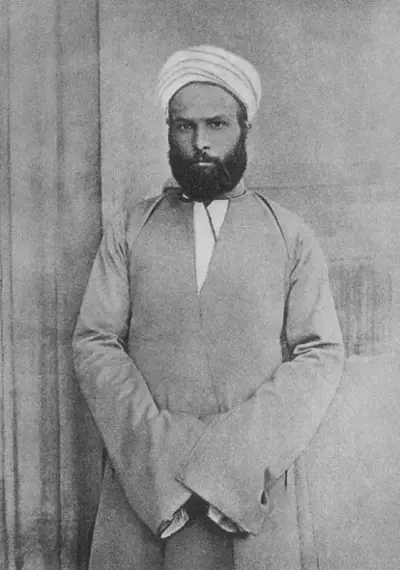
Muḥammad 'Abduh (also spelled Mohammed Abduh, Arabic: محمد عبده) was an Egyptian Islamic scholar, jurist, theologian, mujaddid, Freemason, and writer. He also wrote, among other things, "Treatise on the Oneness of God", and a commentary on the Quran. He briefly published, alongside Jamāl al-Dīn al-Afghānī, the Pan-Islamist anti-colonial journal Al-Urwah al-Wuthqa.
