SAYYID AHMAD KHAN
(Ahmad Taqvi bin Syed Muhammad Muttaqi)
Traditional Islamic education of the time only dealt with the Koran but the skills of modern life, medicine, law, science were taught in the British secular schools, which Muslims generally would not attend. Kahn urged all is fellow Muslims to benefit from all forms of education.
At the time the Colonial British Government controlled the Indian Educational System. Kahn and a few others thought that the Indians should take control of their own educational systems.
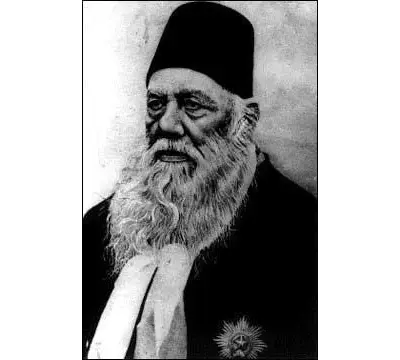
Sir Syed Ahmad Taqvi bin Syed Muhammad Muttaqi KCSI, commonly known as Sir Syed Ahmad Khan (also Sayyid Ahmad Khan), was an Islamic pragmatist, Islamic reformer, philosopher, and educationist in nineteenth-century British India. Though initially espousing Hindu-Muslim unity, he became the pioneer of Muslim nationalism in India and is widely credited as the father of Two-Nation Theory which formed the basis of Pakistan movement. Born into a family with strong debts to the Mughal court, Ahmad studied the Quran and Sciences within the court. He was awarded an honorary LLD from the University of Edinburgh in 1889.
