Sayyid Ahmad Khan Quotes
Any nation wishing to promote national education could not expect to achieve its aims until it took it control of education in its own hands
At the time the Colonial British Government controlled the Indian Educational System. Kahn and a few others thought that the Indians should take control of their own educational systems.
Sayyid Ahmad Khan, 1817-1898, Indian Islamic Modernist & Reformer, Quoted in Achmad Jainuri, The Reformation of Muslim Education: A Study of The Aligarh and The Muhammadiyah Educational System
Sourced by: Eigen's Political and Historical Quotations

Lankester was a preeminent scientist of his day and a leader of the conservative British establishment. Germany had a system of scientific education which at the time was the envy of most other sophisticated countries. It is noteworthy that he was the only conservative who was among the 9 mourners at the funeral of Karl Marx.

The phrase “national care and expense” was one that was seen as precedent for those advocating federal aid to education and a strong Department of Education. However, the majority of Adams contemporaries saw education, even public education, as a local matter. The word “education” or “school” never appeared in the Constitution. Adams was well before his time on this point.

In almost all societies until recent times, many uneducated people—especially from rural areas—were not enthusiastic about sending their children to school. They worried about losing the farm or factory labor of the children, losing control / influence, children learning unacceptable moral or religious ideas, and social mobility was so poor that many parents thought that it would never help the children.

His hope that the elite intelligentsia would lead the nation was thwarted by Islamic fundamentalism which destroyed most of Pakistan education by only teaching religion in its Madrassas and not allowing the leadership to have compulsory education. There has been an enormous brain drain with a huge number of the Pakistani intelligentsia on which Jinnah pinned his hopes, had no opportunity in Pakistan and emigrated to the United Kingdom and America.


England did not follow this precept but the United States did and is the only country that did. In all others, education is controlled by the national government. However, Godwin's principle of separating education from government is not maintained in all the states of America. In many, the State government leaves much of the curriculum and the operations of the school to local school boards which have a great deal of discretion. However, in most of the Southern States, the State government dominates and controls education and relatively little is left to the school boards. In some the State chooses the allowable textbooks. In those cases, Godwin's principle is violated, but in most of the North East and Midwest and some of the far West the school boards have great autonomy and Goodwin's principle is upheld. It is fascinating that the more control a particular state exercises of the schools, the poorer the performance of the schools of that state. Goodwin had a terrific insight.


This plank if ever actually implemented would clearly destroy the American educational system. Extreme radical ideas such as this are not typical of Libertarian Party positions before or afterwards. The quotation illustrates that there are people in America who would end public education if they could. The quotation also illustrates how a small cadre of people can capture control of a political party and create a platform that is their own personal views which may be different from most of the party members or the historical position that the party has taken. In 1980 the Libertarian Party Vice Presidential Candidate was David Koch, one half of the billionaire conservative Koch brothers. Their money financed the Libertarian Party in that year and David Koch’s views then prevailed in the party platform. Historically, the Koch brothers moved from a minor third party to the Republican party at the beginning of the 21st century when their money was able to help drive the party very far to the right from the traditions of Abraham Lincoln and Theodore Roosevelt.


1st Earl of Beaconsfield. This is one of the favorite quotations of those who oppose a strong federal role in education.


L. P. Jacks. Since this quotation education the world over has vastly improved. However arguably, the reasons were not ethics of nations and their leaders but a combination of public demand and the clear coupling of education with necessary qualifications for jobs and scientific and technological development of nations.


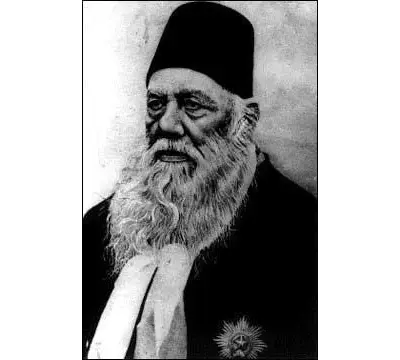
Sir Syed Ahmad Taqvi bin Syed Muhammad Muttaqi KCSI, commonly known as Sir Syed Ahmad Khan (also Sayyid Ahmad Khan), was an Islamic pragmatist, Islamic reformer, philosopher, and educationist in nineteenth-century British India. Though initially espousing Hindu-Muslim unity, he became the pioneer of Muslim nationalism in India and is widely credited as the father of Two-Nation Theory which formed the basis of Pakistan movement. Born into a family with strong debts to the Mughal court, Ahmad studied the Quran and Sciences within the court. He was awarded an honorary LLD from the University of Edinburgh in 1889.
