Ghassan Salame Quotes
Technological innovation is so miserable in the Middle East that, if you exclude Israel, the number of patents filed is less than one fifth the number from sub-Saharan Africa.
What is ironic about this fact is that 1000 years ago, the Muslim Middle East was scientifically and mathematically far in advance of Europe. However, after about 1100 AD, the Muslim religion began to lose its intellectual tolerance and cultural appreciation for science and innovation to the point where innovation of any kind was regarded as heresy, and the logic and empiricism that was present in early Islam disappeared, and there has been little scientific innovation and progress in traditional Arab Islamic nations ever since.
Ghassan Salame, Culture Minister of Lebanon, Senior adviser to The United Nations Secretary General, Lecture, “Is The Middle East Europe's Business?”, London School of Economics, 2008
Sourced by: Eigen's Political and Historical Quotations


The pre WWII Zionists who returned to the Holy Land brought with them, the education, culture, technology, and particularly the modern scientific methods of agriculture and irrigation. The Arabs lived the same way as they had done since 1100 when the Muslim world "closed" to new ideas and change. At that earlier time, the Arabs had the advanced agricultural techniques which Europeans copied throughout Spain and Italy. While advanced for 1100, Arab agriculture was backward by early 20th century standards. Arab farms could mostly just feed the land owning family and produced little surplus, and they wasted huge amounts of water in the process. The returning Jews assumed that the Arabs would welcome these new techniques as well as the public health, medicine, engineering and science. They thought that they were bringing great gifts to the non-Jewish inhabitants of the land. However, even though the Jewish farms improved the quality of the produce and increased the productivity many times with much less water needed, for the most part, the Arabs would not depart from their traditions and religious dictates. One of the reasons Islam had been so successful in its inception was that it prescribed behavior in every phase of life, not just religious. But then it became very difficult to change. So the benefit that the Zionists thought that they were bringing back to the Middle East were not seen as benefits by the Arabs whose various cultures and countries have remained religiously and tradition bound even into the 21st century.

The Israeli Arabs have a much higher standard of living than their coreligionists in the Arab controlled parts of Palestine and even Eqypt.See {588743} for more information that is related.


First Muslim to win the Nobel Prize
10 centuries ago was a time when the Arabs were far more advanced and modern than other cultures including the Christian West that was in the Dark Ages. However, in the 12th century there was a “closing”—a narrowing of allowable Islamic thinking, and since then, Islamic people have had great difficulty with change or modernity. Not all Muslim nations are equally rigid but the Arabs are at the extreme among Islamic counties.


While Peres and many others think that the Arab nations can become developed countries, there are major barriers in the way. One is oil. No country that has had a great deal of oil has ever developed. Then there is education. Israel’s technological success requires a very high level of education in secular subjects which no Arab nation provides. The Western cultural values of inquiry, freedom of thought, individuality are were in large part developed from the traditional Jewish values. The Muslims had these at the early 2nd millineum. But political and religious forces since then, have created contemporary Arab cultures whose vaues are in many ways antithetical to modern technological development.


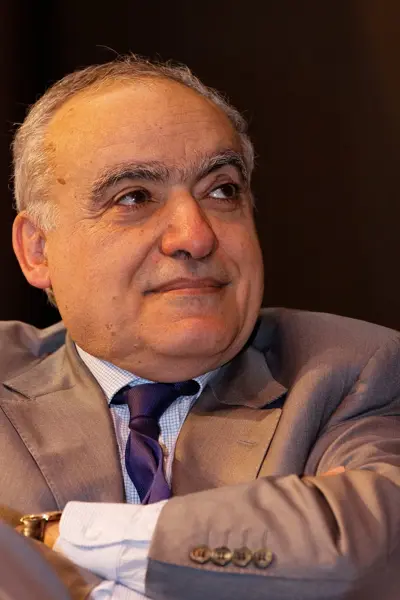
Ghassan Salamé (Arabic: غسان سلامة; born 1951) is a Paris-based Lebanese academic. He served as the Lebanese Minister of Culture from 2000 to 2003. He was the Dean of the Paris School of International Affairs (PSIA) and professor of International Relations at Sciences Po. Salamé served as the head of the United Nations Support Mission in Libya from 2017 to 2020.
