Ismail Serageldin Quotes
Science requires much more than money and projects. Science requires freedom: freedom to enquire, to challenge, to think, and to envision the unimagined. We must be able to question convention and arbitrate our disputes by the rules of evidence. It is the content of scientific work that matters, not the persons who produced it, regardless of the color of their skin, the god they choose to worship, the ethnic group they were born into, or their gender. These are the values of science, but even more, they are societal values worth defending, not just to promote the pursuit of science but to have a better and more humane society.
Islamic modernists like Serageldin are many among the educated Muslims but their views are often drowned out by the violence and extremist statements of the fundamentalists. Ironically, the necessary intellectual freedom existed in the Islamic world one thousand years ago and Islamic science and other learning was as advanced as any and superior to most including the Christians.
Ismail Serageldin, Egyptian Director of the Library of Alexandria & Historian, Member of the Egyptian Senate & World Bank Enviornmental VP & World Bank Enviornmental VP & World Bank Enviornmental VP, Editorial in Science, August 8, 2008
Sourced by: Eigen's Political and Historical Quotations

In 2005 an Egyptian writer, Usama Anwar Ukasha, criticized one of the Prophet’s companion’s role for causing dissention and divisiveness in Islamic history. Some called for his legal punishment for slandering a holy figure (see {588714}) and a law case was brought to force him to divorce his wife—so that she would not be “contaminated by his heretical thoughts. Al-Bana argued for freedom of thought and speech on such subjects. His view was particularly important since he was the brother of Hassan Al-Bana, the founder of the Muslim Brotherhood, a powerful fundamentalist organization. Note that Al-Bana’s call for intellectual freedom does not go so far as to say that it should be legal to criticize The Prophet Muhammad and it illustrates how far even modern Islam has to go to meet reasonable standards of freedom of thought and speech.

Islamic modernists like Serageldin are many among the educated Muslims but their views are often drowned out by the violence and extremist statements of the fundamentalists.


The Scientific Project that developed the Atomic Bomb. Oppenheimer was the great physicist who directed the successful development of the atomic bomb so as to build the weapon before Hitler did in World War II. However, as the technology evolved, he had doubts as to the wisdom of creating even more powerful hydrogen weapons. His viewpoint was hurting the administration’s policy of rapid unlimited nuclear weapons development, and he was the victim of a character assassination whereby his security clearance was withdrawn. The “father” of the atomic bomb was the first American casualty of atomic weapons development.
Islamic modernists like Serageldin are many among the educated Muslims but their views are often drowned out by the violence and extremist statements of the fundamentalists. This quotation is similar to statements by American Supreme Court Justices but surprises us when coming from a Muslim. But there are many who are as much committed to freedom of speech as most Americans. Even in America, some politicians have tried to make incitement a crime. John Adams’ Alien & Sedition Acts and laws of WWi are examples. However, in no Islamic nation have reformers had incitement removed as a crime as of 2011.


In many nations, including the United States on occasion, governments have made laws as to what is valid science and what is not. Tennessee and other Bible-Belt States have and still do on occasion. The latest being Evolution, which even in the beginning of the 21st century, Kansas determined that it was not proven science, when it is as proven as any science has ever gotten.


Ibn al-Nafis was one of the great scientists of all time. He analyzed the human heart, lungs, and circulatory system. This quotation is often given by Muslim modernists and reformers to illustrate that Islam at one time was open to new knowledge, dissent, ideas of all kinds. A century later, Islam closed intellectually and later and even today, Muslims are killed for what became heresy. Truth became determined by the Koran and the words of The Prophet only, Christianity and the Church imposed a similar restrictive view of truth using the Bible and Jesus. However, the Reformation and modernity led Christianity to merge and adopt the more modern and scientific view with the exception of some Christian fundamentalists. Islam had the modern view and abandoned it causing the many educated Islamic reformers and modernists of today great difficulty in changing the culture and laws as a whole.

This is a very important quotation. The reason is that the Secretary General of the UN backed off and did not support the absolute right of freedom of speech and expression. He favored allowing exceptions. In this case a film was made that was not only intellectually an attack on Islam but it was done in such a manner that most orthodox Muslims were insulted and offended that their Prophet and religion were both insulted in a blasphemous manner. It was a film that was very much in poor taste, insensitive and gross. One major difference between freedom of speech as interpreted by most countries and the United States is that most other nations do not allow and defend hate speech and material that insults a people or their religion or is blatantly blasphemous. The U. S. however protects anyone who blasphemously attacks anyone or any group for any reason. There are a few other nations that protect free speech absolutely but Germany, the United Kingdom, Israel, and India are considered major examples of democracy and freedom and yet they do not protect free speech absolutely. In most Muslim nations, whatever freedom of speech they might have does not apply to blasphemy where Islam is concerned. In most of the Arab nations, there is rank hypocrisy in that freedom of speech is tolerated and protected if there is a blasphemous attack on any other religion such as Christianity, Judaism, Buddhism, or Bhai. This kind of difference on human rights between the U. S. and the UN causes many Americans to oppose the US participation in UN operated courts and projects to protect human rights. Few Americans would favor being a part of an international court system where an American could be convicted of blasphemy for what he had written or said. Essentially, the Secretary General has taken a stand against the United States Constitution and the values of most Americans and many other people of the world like Denmark, or Norway. Offensive and insulting speech is the only kind of speech that needs protection. If speech offends no one, there is no need for its protection.


Islamic modernists like Serageldin are many among the educated Muslims but their views are often drowned out by the violence and extremist statements of the fundamentalists.


_0_thumbnail_47x47.jpg)

See Sidney Hook for a later, similar view: {603761} Ingersoll was considered to be the greatest orator and political thinker of his day, but his overt atheistic views curtailed his elected political career.

Islam had been the center of intellectual thought in the world, until the clerics had decided that innovation itself was a sin and one that called for the death penalty. Although most non-Muslim religions went through stages of death for religious dissent. However, the Koran deals with every part of society. There is no separation of church and state. All knowledge is in the Koran the fundamentalist believes and anyone who expresses a new idea is not only wrong and a heretic, but is dangerous and must be executed. It is therefore not very surprising that the Islamic contributions to science, medicine, and the arts has been so small. The Islamic fundamentalists are opposed by Muslim modernists who try to change the Islamic culture but they are on the minority. Most religions have gone through bad earlier periods where dissent was heresy and warranted death. Fundamentalist Islam is the only one which bans original thought of any kinds even it does not contradict established doctrine.
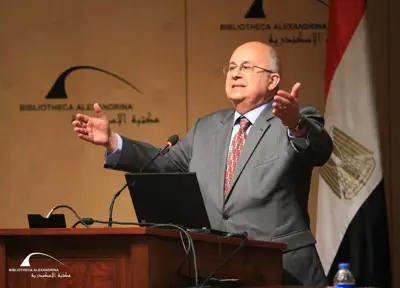
Ismail Serageldin (/ˈsɛrəɡɛldɪn/; born 1944 in Giza, Egypt), Founding Director of the Bibliotheca Alexandrina (BA), the new Library of Alexandria, inaugurated in 2002, is currently, Emeritus Librarian, and member of the Board of Trustees of the Library of Alexandria. He serves as Chair or Member of a number of advisory committees for academic, research, scientific and international institutions and civil society efforts, including as co-Chair of the Nizami Ganjavi International Center (NGIC), and serves on the Advisory Committee of the World Social Science Report for 2013 and 2016, as well as the UNESCO-supported World Water Scenarios (2013) and the executive council of the Encyclopedia of Life (2010) and Chairs the Executive Council of the World Digital Library (2010). He also co-chaired the African Union's high level panel for Biotechnology (2006) and again for Science, Technology and Innovation (STI) in 2012–2013, and was a member of the ICANN Panel for the review of the internet future (2013).
