Richard P. Feynman Quotes
No government has the right to decide on the truth of scientific principles, nor to prescribe in any way the character of the questions investigated…. it has a duty to its citizens to maintain the freedom, to let those citizens contribute to the further adventure and the development of the human race
In many nations, including the United States on occasion, governments have made laws as to what is valid science and what is not. Tennessee and other Bible-Belt States have and still do on occasion. The latest being Evolution, which even in the beginning of the 21st century, Kansas determined that it was not proven science, when it is as proven as any science has ever gotten.
Richard P. Feynman, 1918-1988, Nobel Laureate in Physics, Member, Commission investigating the Challenger accident, The Meaning of It All: Thoughts of a Citizen Scientist, 1999
Sourced by: Eigen's Political and Historical Quotations


The Scientific Project that developed the Atomic Bomb. Oppenheimer was the great physicist who directed the successful development of the atomic bomb so as to build the weapon before Hitler did in World War II. However, as the technology evolved, he had doubts as to the wisdom of creating even more powerful hydrogen weapons. His viewpoint was hurting the administration’s policy of rapid unlimited nuclear weapons development, and he was the victim of a character assassination whereby his security clearance was withdrawn. The “father” of the atomic bomb was the first American casualty of atomic weapons development.

Islamic modernists like Serageldin are many among the educated Muslims but their views are often drowned out by the violence and extremist statements of the fundamentalists. Ironically, the necessary intellectual freedom existed in the Islamic world one thousand years ago and Islamic science and other learning was as advanced as any and superior to most including the Christians.


The societies that had regularly produced the great advances in the sciences were those that allowed its citizens much liberty—liberty of thought, expression, association, etc. Where religious dogma controlled thought and expression, great scientific achievements were far less probable or less productive. Imagine, what Galileo might have achieved if the Church had not curtailed his efforts. When Islamic society was open, the sciences flourished whereas they were stifled in Christian Europe, but once Islam closed and liberty was no more, Islamic science degenerated to its low point of the 21st century.


Astronomy and physics were followed by chemistry and then geology and biology, and more recently we have genetics, in vitro fertilization and cloning.


The justice was ruling that copyright did not preclude fair use by others for educational and scientific purposes.


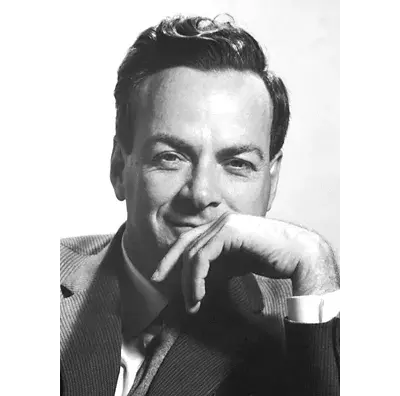
Richard Phillips Feynman was an American theoretical physicist and Nobel Prize winner who made significant contributions to quantum mechanics, quantum electrodynamics, and particle physics. He's known for his work on the Manhattan Project, developing Feynman diagrams, and explaining the interactions between light and matter. While studying for his PhD, Feynman participated in the Manhattan Project and helped develop the atomic bomb. For contributions to the development of quantum electrodynamics, Feynman received the Nobel Prize in Physics in 1965 jointly with Julian Schwinger and Shin'ichirō Tomonaga.
