William Smyth Quotes
Men must also be allowed the publication of their opinions, if this be done with decency and seriousness, for the learned can have no right to say that they are in possession of the truth, still less can the unlearned, unless every grave man can offer his opinions, be they what they may…
William Smyth, 1765–1849, English Historian, Lectures on Modern History, published 1854
Sourced by: Eigen's Political and Historical Quotations

Ingersoll was considered to be the greatest orator and political thinker of his day, but his overt atheistic views curtailed his elected political career.


After being criticized for printing a ship captain's advertisement that excluded clergymen as passengers, local clergy threatened to boycott the Gazette and take no printing jobs to Franklin. Due to the resulting clamor, Franklin published this "apology," i.e. apologetics, a statement of his philosophy as a printer, and concludes by explaining how and why he printed the offending handbill and why he should not be censured for the act.

In 2005 an Egyptian writer, Usama Anwar Ukasha, criticized one of the Prophet’s companion’s role for causing dissention and divisiveness in Islamic history. Some called for his legal punishment for slandering a holy figure (see {588714}) and a law case was brought to force him to divorce his wife—so that she would not be “contaminated by his heretical thoughts. Al-Bana argued for freedom of thought and speech on such subjects. His view was particularly important since he was the brother of Hassan Al-Bana, the founder of the Muslim Brotherhood, a powerful fundamentalist organization. Note that Al-Bana’s call for intellectual freedom does not go so far as to say that it should be legal to criticize The Prophet Muhammad and it illustrates how far even modern Islam has to go to meet reasonable standards of freedom of thought and speech.
In 1989 the leader of Iran, Ayatollah Khomeini, claimed that Salmon Rushde, a British author and Iranian native, had written a blasphemous book and should therefore be killed. Not all Muslim spiritual leaders agreed:. 6 weeks after making this statement on television, he himself was assassinated.


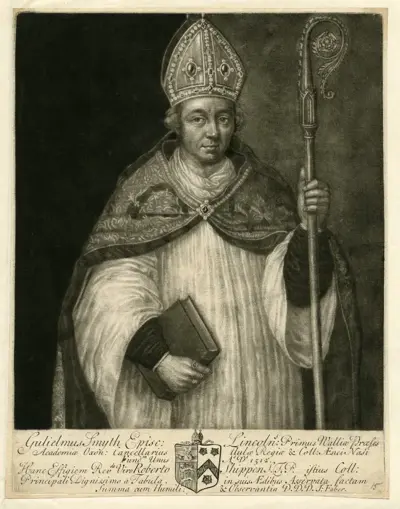
William Smyth (or Smith) was Bishop of Coventry and Lichfield from 1493 to 1496 and then Bishop of Lincoln until his death. He held political offices, the most important being Lord President of the Council of Wales and the Marches. He became very wealthy and was a benefactor of a number of institutions. He was a co-founder of Brasenose College, Oxford and endowed a grammar school in the village of his birth in Lancashire.
