Pius XI Quotes
No one can be at the same time a sincere Catholic and a true Socialist
While this was his opinion, it was never issued in a Papal Bull or had the force of Catholic law. Meanwhile, almost all of the socialist movements in the West have had Catholics in their leadership and many democrats of modern times would have been considered socialist. Many countries with high proportions of Catholic voters have elected socialist governments in secluding Spain and Italy.
Pius XI, 1857-1939, [Achille Ratti], Roman Catholic Pope, 1931
Sourced by: Eigen's Political and Historical Quotations


Marqués de Valdegamas. He was a descendant of the conquistador, Hernando Cortez.

The Protestant Clergy issued similar statements. This was one of the few areas of agreement.


This was a very important historical quotation. In 1928 Al Smith, the Governor of New York, was the Democratic Candidate for President. He was the first Roman Catholic to run for the Presidency for a major party. He narrowly lost and the anti-Catholic sentiment of much of the country was one of the major reasons, Jones was one of the many Protestant religious leaders who were virulently opposed to a Roman Catholic in the White House. The analogy of a saloon on every corner was very important at the time as the United States had Prohibition, and alcohol had been Jones’ major issue beore then. The result was the election of Herbert Hoover and the subsequent Great Depression.

In this speech, and in {634756}, he argued against unification to a public that was mostly opposed. The leadership was interested because they were facing the Muslim Ottoman Turks who were getting more powerful each day. The Eastern Emperor, Constantine XI, more of a soldier and politician than a cleric, wanted the military strength of the Franks and other Western European Christian armies to help protect the Eastern Empire and Byzantium and were willing to reunite under the Pope to get it. Gennadios and his faction were not. They prevailed and the next year, the Muslims conquered Byzantium which had little help from the armies of the Western Roman Empire.


It took only 10 days after the First Continental Congress met for religious bigotry to arise. After hundreds of years of Catholic/Protestant strife, each sect looked upon the other, not only as theologically wrong, but dangerous to the liberty of the other. Unfortunately, the organied religions had acted so badly towards other religions, that everyone was justified in fearing the other religions. This quotation illustrates a then typical attitude of many American Protestants that the Catholic Church was a threat to national security. Ironically, in modern times, anti-Catholic bigots use this quotation to demonstrate that the United States was founded as a Christian Protestant nation—not a general Christian nation. A small, vicious anti-Catholic sentiment still exists, usually by a minority of right wing Protestant religious fundamentalists. Protestant England had just repealed the laws making Catholicism illegal, but this was regarded at that time as intolerable for the new America. This was one of the disputes which that the Founding Fathers were faced with later and one of the reasons that they were so absolute in the need for the 1st Amendment.
This began the Church's most notorious attack on any dissent or disagreement and it was the start of the Inquisition.

Kennedy was being hurt be fears that as a Catholic, he would be beholden to the Pope and the Catholic Bishops. There were many protestants who believed that the Catholic Church was antithetical to democracy and some who even believed that Catholicism was the religion of Satan. Kennedy decided to confront the issue head on.


The archbishop of Toledo, Cardinal Pedro Segura, had put the Catholic Church in the midst of the political struggle siding with the Fascists against the Republicans. In retaliation, several Catholic churches and convents were burned. The Cardinal and others wanted to take severe reprisals against the Republicans.
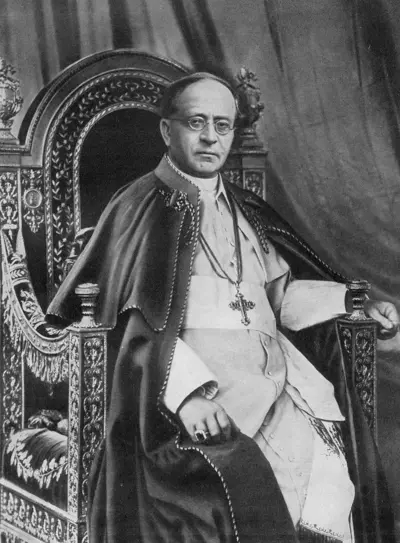
Pope Pius XI (Italian: Pio XI), born Ambrogio Damiano Achille Ratti, was head of the Catholic Church from 6 February 1922 to his death in 1939. He was the first sovereign of Vatican City from its creation as an independent state on 11 February 1929. He took as his papal motto "Pax Christi in Regno Christi," translated "The Peace of Christ in the Kingdom of Christ."
