Thomas Aquinas Quotes
All admit that indulgences have some value; for it would be blasphemy to say that the Church does anything in vain.
Much of the Catholic Church was greatly influenced by Aquinas long past his death. This quotation laid the foundation for the view, that anything the Church does, even if seemingly wrong or absurd, has some positive value. Here, Aquinas refused to totally condemn the Church practice of giving indulgences (official absolution for serious sins) to the rich in exchange for money. His view assumes that there must be some good in all acts of the church, even if we can not now determine it. This view makes reform very difficult even after the evil is recognized. Some theologians argue that although this perpetuates some bad practices, it provides stability and prevents leaders of the church from constantly trying to adapt the church to meet current popular or civil criticism.
Thomas Aquinas, ~1225-1274, Catholic Saint & Italian Scholastic Philosopher, Summa Theologica
Sourced by: Eigen's Political and Historical Quotations

The King had earlier replaced the Pope as the head of the English church. The references to money referred to a then common corruption of the Church whereby people could buy indulgences—religious papal pardons of past or future sins. This was a major revenue source for the Vatican and a major issue for Martin Luther and the Protestant Reformers some of who saw the pope as the Devil incarnate See {623153}. For Martin Luther’s view pf the practice and {626720}, {595195}, and {639436} for other contemporary views.


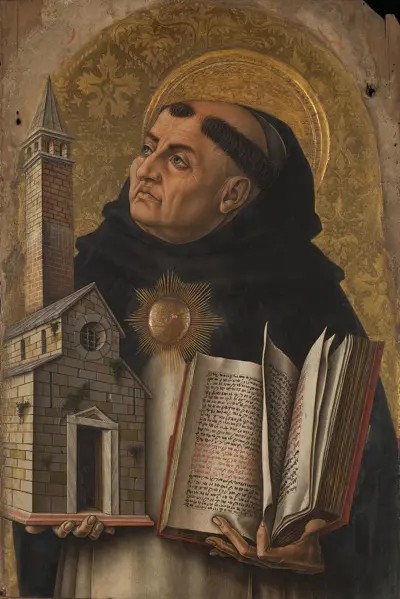
Thomas Aquinas was an Italian Dominican friar, philosopher, Catholic priest, and Doctor of the Church. An immensely influential philosopher, theologian, and jurist in the tradition of scholasticism, he is also known within the latter as the Doctor Angelicus, the Doctor Communis, and the Doctor Universalis. The name Aquinas identifies his ancestral origins in the county of Aquino in present-day Lazio, Italy. Among other things, he was a prominent proponent of natural theology and the father of a school of thought (encompassing both theology and philosophy) known as Thomism. He argued that God is the source of both the light of natural reason and the light of faith. His influence on Western thought is considerable, and much of modern philosophy developed or opposed his ideas, particularly in the areas of ethics, natural law, metaphysics, and political theory.
