Innocent III Quotes
We believe that you know how pernicious the vice of usury is …. We command you all by this apostolic writing not to permit those who are known as usurers to clear themselves by any subterfuge or trick when they are charged with the crime.
Innocent III, ~1160-1216, Roman Catholic Pope, Letter to the French bishops, 1198
Sourced by: Eigen's Political and Historical Quotations


The struggle in the Catholic Church reached an amazing state. Just after a new pope, Martin V, had been elected the Council of Bishops at Constance came up with this notion which placed their views above those of the Pope under the theory that this particular council derived its power and authority directly from Christ while the pope was only God’s “vicar on earth.” The struggle was somewhat akin to the inevitable struggle for power between an executive branch and a legislative branch. The Council’s ascendancy didn’t last very long and was repudiated by successive popes.


Manava Dharma Shastra. Ancient Jewish law prohibited the charging of interest. The early Christian world frowned upon it and morally and legally vacillated from time to time. Islam outlawed interest completely and some orthodox Muslims and Muslim counties loans with interest are illegal. However the ancient Hindus not only allowed interest but felt that it was such an important component of the economy that there were numerous regulations, religions and legal regulating it. This example made 5 percent the maximum allowable interest rate. This text is a part of the Hindu Holy Texts. Hindus believe that Manu was a prophet whose text is revealed or inspired.

The Pope was justifying his earlier excommunication of Holy Roman Emperor Henry IV who in turn excommunicated Pope Gregory.

He was the only English Pope. This was the authority that enabled English King Henry II to invade Ireland. Many historians consider it the beginning of the problems between the Ireland and England which persists to this day. See {610520}. Some scholars think that this bull was a forgery stating that the writing style was different from other bulls of Adrian IV. Opponents believe that a change in secretaries could easily have accounted for the difference.


He was the last Pope to hold temporal power.


The Vatican & the Chinese Communist Government had been at odds for years with much of the Chinese church going underground. Fr. Jin had been jailed for a decade. Then the government allowed him and the Catholic Church and operate openly, but there were still Vatican conflicts over numerous issues including the right of the Government to approve senior appointments of church officials—a privilege the church claimed exclusively. The Vatican ordered Jin not to cooperate and especially not to reopen the national theological seminary which the government had ordered closed. There had been no training for Chinese priests and Jin wanted to reopen the national theological seminary but the Vatican refused cooperation waiting for the government to capitulate to the Vatican’s various demands. Fr. Jin defied the Vatican & reopened the seminary. Without officially admitting their failed tactics, the Vatican let the discipline issue against Jin drop & the national theological seminary thrived.

Essentially, the Council voted to close all the banks of the day and get rid of all the bankers. Without banking economic development of Christian (Catholic) Europe stagnated and did not thrive until the Borgia’s used their banking prowess to actually attain the Papacy. Ironically, Christians, Jews and Muslims all had banned banking—usury—the charging of interest for borrowed money—as a serious sin. To this day there are orthodox fundamentalists of all three religions who decry modern banking, but the majority of Christians and Jews no longer have any problem with banking, and while the Muslims generally still decry it as a sin, the wealthy Muslims have come up with various fig leaves where they pretend that banking us not usury, and in the modern world, although they are castigated by a mullah or two, the essence of capitalism goes on even in Muslim countries.

He was against paper money. At the time, any bank could issue its own paper money or “banknotes”. However other banks would not redeem the banknotes for the full amount; they would “discount” the note. Usually, the further away the bank was from the original bank, the more discount they took. Interstate commerce was almost impossible. Alexander Hamilton, Jefferson’s nemesis, had a much more modern point of view and fortunately his view prevailed. Paper money could only work if it was issued by a central bank with no discounting by other banks. The paper money had to be “legal tender”.


In 1877 Wasburn was dropped from the List of Ministers by the Unitarian Church. He had become very critical of organized and orthodox religion of all kinds.

The letter was written at the behest of the Archbishop of Canterbury. The quotation appears to ratify the Pope’s unlimited power, but in actuality carves out an exception whereby the Pope’s authority might be challenged in the future. Specifically, it claims the Pope has not the authority to alter that which “by the word of God, has eternal validity.” Politically, this position put the pope in a box. By arguing against the proposition, the Pope would have to maintain that he should have the right to alter the word of God that had eternal validity which no pope wanted to state. By not challenging the doctrine, there was an opening by which the pope’s omnipotence could be challenged in the future.

The bill which passed required people who went into bankruptcy to continue to pay for credit card obligations incurred before the bankruptcy except if they are very rich and have bought very expensive homes in the five states which offer this shelter.

Many of the Church wanted Wycliff excommunicated, but the King and Parliament seemed to like his writing and sermons. So he was protected in his lifetime. He died at the age of 60 of a stroke. After his death the Church burned all his books that had been banned, and exhumed his body. That was burned at the stake and his ashes scattered in a river. Martin Luther did not try to reform the Church in a vacuum. There had been various critics of the Church before Luther and Wycliff was one. The last statement in this quotation was the one that really hit the then mostly corrupt clergy where it hurt.

The council was not only fearful of Protestant preaching, but hereby granted a local monopoly within the Catholic Church to the local Bishop.
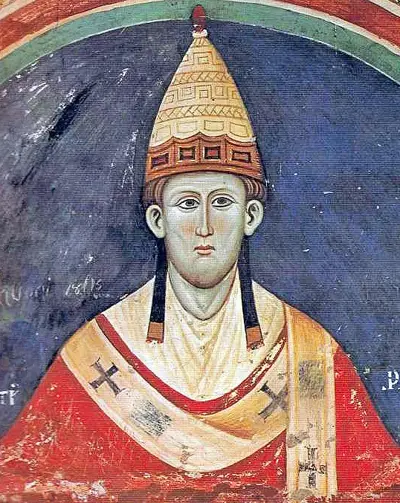
Pope Innocent III was the 176th Pope of the Catholic Church from 8 January 1198 to his death.
