MANU
Manava Dharma Shastra. The punishment for male adultery was not capital as in the Ancient Jewish and early Christian and Muslim law (Sharia) even today. However, if the adulterer had relations with the wife of a higher cast man, then the punishment was death. Even intercourse with an unmarried woman of a higher caste was punishable by death, but not so for relations with a woman of the same or lower caste. This text is a part of the Hindu Holy Texts. Hindus believe that Manu was a prophet whose text is revealed or inspired.
Manava Dharma Shastra. Fundraisers, have even in ancient Hindu India, have long been appointed to key government posts. This text is a part of the Hindu Holy Texts. Hindus believe that Manu was a prophet whose text is revealed or inspired.
Manava Dharma Shastra. This text is a part of the Hindu Holy Texts. Hindus believe that Manu was a prophet whose text is revealed or inspired. This is one of the earlier prescriptions to maintain public health.
Manava Dharma Shastra. This text is a part of the Hindu Holy Texts. Hindus believe that Manu was a prophet whose text is revealed or inspired.
Manava Dharma Shastra. This text is a part of the Hindu Holy Texts. Hindus believe that Manu was a prophet whose text is revealed or inspired.
Manava Dharma Shastra. This text is a part of the Hindu Holy Texts. Hindus believe that Manu was a prophet whose text is revealed or inspired.
Manava Dharma Shastra. This text is a part of the Hindu Holy Texts. Hindus believe that Manu was a prophet whose text is revealed or inspired.
Manava Dharma Shastra. This text is a part of the Hindu Holy Texts. Hindus believe that Manu was a prophet whose text is revealed or inspired.
Manava Dharma Shastra. The caste system in action. Note however that the highest caste aristocrats could not abuse even lower caste women with impunity the way that was common in early Christian Europe. However, the punishment was not death as required by Muslim law—see {590409}. This text is a part of the Hindu Holy Texts. Hindus believe that Manu was a prophet whose text is revealed or inspired.
Manava Dharma Shastra. These were the proper allowable taxes in the Ancient Hindu system. This translates to two percent of cattle or gold and at most 17 percent of the crops. Most industrialized democracy citizens would be very happy to have this low a tax burden. Conversely, the tax rates of modern democracies are sinful by Ancient Hindu standards. This text is a part of the Hindu Holy Texts. Hindus believe that Manu was a prophet whose text is revealed or inspired.
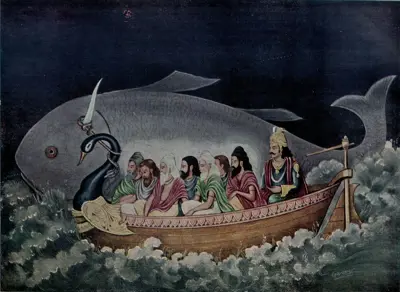
Manu (Sanskrit: मनु) is a term found with various meanings in Hinduism. In early texts, it refers to the archetypal man, or to the first man (progenitor of humanity). The Sanskrit term for 'human', मानव (IAST: mānava) means 'of Manu' or 'children of Manu'. In later texts, Manu is the title or name of fourteen mystical Kshatriya rulers of earth, or alternatively as the head of mythical dynasties that begin with each cyclic kalpa (aeon) when the universe is born anew. The title of the text Manusmriti uses this term as a prefix, but refers to the first Manu – Svayambhuva, the spiritual son of Brahma.
