Pope Gregory VII Quotes
In the name of God almighty, the Father, the Son, and the Holy Ghost..., I withdraw the government of the whole kingdom of the Germans and of Italy from Henry the King, son of Henry the Emperor. For he has risen up against thy church with unheard of arrogance. And I absolve all Christians from the bond of the oath that they have made to him or shall make. And I forbid anyone to serve him as king.
The Holy Roman Emperor and the Pope were at odds. The Pope had issued an edict staking out the powers of the Pope. King Henry called a conclave of clerics and deposed Pope Leo VII. The Pope Excommunicated Henry and deposed him as king and emperor. Civil war ensued, and finally they reached a compromise and accommodation with each other." Saint Hildebrand
Gregory VII, c. 1020-1085, , Roman Catholic Pope and Saint, Edict Deposing King Henry IV, February 1076
Sourced by: Eigen's Political and Historical Quotations


Wycliffe, although a Roman Catholic, was an early reformist. He not only opposed the Pope vis a vis King Edward of England, but he went against church doctrine and printed the first English Bible. He was burned at the stake.

This notice of Excommunication was promulgated to the Catholic clergy in Ireland in May of 1538. It required all Roman Catholic leaders to size the property of Protestants or Catholics who sympathized with them. Those who did were then regarded as traitors by the Protestant King. The anti-Protestant feeling culminated with the massacre of about 100 Protestants who were drowned in Bann a few years later.

The Holy Roman Emperor and the Pope were at odds. The Pope had issued an edict asserting Papal power that angered Henry and many clerics. King Henry called a conclave of clerics and "deposed" Pope Leo VII. The Pope Excommunicated Henry and "deposed" him as king and emperor. Civil war ensued, and finally they reached a compromise and accommodation with each other." Heinrich IV


Some politicians then and later were not as religious as the leading clerics would prefer. The quotation shows that priests commonly married at that time even though the church had forbidden it.

The church was in constant roil with the Bishops, the Pope and the Holy Roman Emperor each striving for superiority over the other two, almost like branches of government fighting for power. This was the bishops attempt to “impeach” the Holy Roman Emperor. (See {610981} ). The Emperor then wrote to all the kings of Christian Europe pointing out that if the Bishops could unseat the Holy Roman Empire by excommunicating any loyal subjects, then they could do so against any king.


The letter was written at the behest of the Archbishop of Canterbury. The quotation appears to ratify the Pope’s unlimited power, but in actuality carves out an exception whereby the Pope’s authority might be challenged in the future. Specifically, it claims the Pope has not the authority to alter that which “by the word of God, has eternal validity.” Politically, this position put the pope in a box. By arguing against the proposition, the Pope would have to maintain that he should have the right to alter the word of God that had eternal validity which no pope wanted to state. By not challenging the doctrine, there was an opening by which the pope’s omnipotence could be challenged in the future.


What Alcuin did not say was that Charlemagne had the largest and most powerful army.


Smith was the first Roman Catholic to run for President. He was very popular but there was a substantial amount of anti-Catholicism in America at the time. He lost, probably by the margin of the anti-Catholic vote.

The struggle in the Catholic Church reached an amazing state. Just after a new pope, Martin V, had been elected the Council of Bishops at Constance came up with this notion which placed their views above those of the Pope under the theory that this particular council derived its power and authority directly from Christ while the pope was only God’s “vicar on earth.” The struggle was somewhat akin to the inevitable struggle for power between an executive branch and a legislative branch. The Council’s ascendancy didn’t last very long and was repudiated by successive popes.


His response was to being asked whether he could do something with Russian Catholics to help Laval win favor with the Pope, to counter the increasing threat of Nazism. This quotation is often used as an example of Stalin’s disrespect for the Papacy. However, in this case, the Pope was extremely weak politically and some argue spiritually for he did not oppose Hitler and the Nazis very much. Defenders of the Papacy argue that Hitler had overwhelming force and little respect for the Pope, and ironically this was what Stain was referring to. Ironically, another Pope, John Paul, had a major part in bring down the Soviet Union and he had no divisions.


England had, under Henry VIII, left the Roman Catholic Church where the King replaced the Pope as head of the English Church. Henry’s successors then had to organize and manage the national Christian church. James was discussing the hierarchy of the Church of England and there was a suggestion that Bishops be eliminated and have every priest directly responsible to the crown. Bishops would be powerful figures who might form a power center. (They did later). However, King James I observed that the King is God’s choice and rules by divine right. So there had to be bishops to crown kings. The bishoprics were retained.
King Henry VIII had left the Roman Catholic church and taken England and Ireland out also. He replaced the Pope as the head of the English and Irish churches. There was much opposition in Ireland and the priests were the most assertive opponents to the change and were still loyal to the Pope. Queen Elizabeth continued to have problems with the Priests. James I, Elizabeth’s successor, became fed up by the Roman Catholic Priests and therefor issued this Proclamation.

He became furious when the Pole had visited his country and there were so many people who anted to see the Pope that Manila traffic was totally jammed and gridlocked. This quote was the President’s reaction to the snarled traffic.

This was before the state had officially sanctioned and accepted the church. Most of the institutions were pagan and the kings had subjects of both religions with Christianity not yet dominant. Yet among Christians, the Church had government temporal power, even before the church was allied with the state.
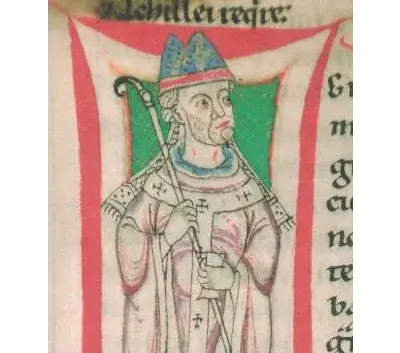
Pope Gregory VII, born Hildebrand of Sovana (Italian: Ildebrando da Soana), was pope from 22 April 1073 to his death in 1085. He is venerated as a saint in the Catholic Church.
