Alcuin Quotes
Up to this point three people have held the highest position in the world: The Pope, The Emperor, The King of the Franks. You are more noble in your wisdom. You are more inspiring in the dignity of your kingdom. The well-being of the churches of Christ rests on you alone.
What Alcuin did not say was that Charlemagne had the largest and most powerful army.
Alcuin [Flaccus] of York, ~735-804, English Scholar & Abbot, Advice to Charlemagne, King of the Franks, Quoted in Becher, Charlemagne
Sourced by: Eigen's Political and Historical Quotations

England had, under Henry VIII, left the Roman Catholic Church where the King replaced the Pope as head of the English Church. Henry’s successors then had to organize and manage the national Christian church. James was discussing the hierarchy of the Church of England and there was a suggestion that Bishops be eliminated and have every priest directly responsible to the crown. Bishops would be powerful figures who might form a power center. (They did later). However, King James I observed that the King is God’s choice and rules by divine right. So there had to be bishops to crown kings. The bishoprics were retained.

The Holy Roman Emperor and the Pope were at odds. The Pope had issued an edict staking out the powers of the Pope. King Henry called a conclave of clerics and deposed Pope Leo VII. The Pope Excommunicated Henry and deposed him as king and emperor. Civil war ensued, and finally they reached a compromise and accommodation with each other." Saint Hildebrand

There was a continuing power struggle between the more powerful kings of Europe and the Roman Catholic Pope. This struggle however was not one of church and state. Neither the kings nor the clergy viewed the two as separate domains. Instead they saw the two in much the same way as the ancient Jews and many contemporary Muslims view relationship—as an inseparable amalgam. However there was much debate over who could best protect and manage the amalgamated entity. In this case Alcuin was arguing that Charlemagne could ensure the well-being of the church better than the Pope. The power struggle went on for centuries between more or less able, powerful, and corrupt kings and popes.


The church was in constant roil with the Bishops, the Pope and the Holy Roman Emperor each striving for superiority over the other two, almost like branches of government fighting for power. This was the bishops attempt to “impeach” the Holy Roman Emperor. (See {610981} ). The Emperor then wrote to all the kings of Christian Europe pointing out that if the Bishops could unseat the Holy Roman Empire by excommunicating any loyal subjects, then they could do so against any king.

The letter was written at the behest of the Archbishop of Canterbury. The quotation appears to ratify the Pope’s unlimited power, but in actuality carves out an exception whereby the Pope’s authority might be challenged in the future. Specifically, it claims the Pope has not the authority to alter that which “by the word of God, has eternal validity.” Politically, this position put the pope in a box. By arguing against the proposition, the Pope would have to maintain that he should have the right to alter the word of God that had eternal validity which no pope wanted to state. By not challenging the doctrine, there was an opening by which the pope’s omnipotence could be challenged in the future.


His response was to being asked whether he could do something with Russian Catholics to help Laval win favor with the Pope, to counter the increasing threat of Nazism. This quotation is often used as an example of Stalin’s disrespect for the Papacy. However, in this case, the Pope was extremely weak politically and some argue spiritually for he did not oppose Hitler and the Nazis very much. Defenders of the Papacy argue that Hitler had overwhelming force and little respect for the Pope, and ironically this was what Stain was referring to. Ironically, another Pope, John Paul, had a major part in bring down the Soviet Union and he had no divisions.

Wycliffe, although a Roman Catholic, was an early reformist. He not only opposed the Pope vis a vis King Edward of England, but he went against church doctrine and printed the first English Bible. He was burned at the stake.


This concept of separation of church and state divided the society into two domains and had the Emperor rule and the church, the other.

Typical of the times, the king was accountable to no one for anything. 200 years later, most of the world have accepted the principle that no one is above the law and that every leader is accountable to the people.


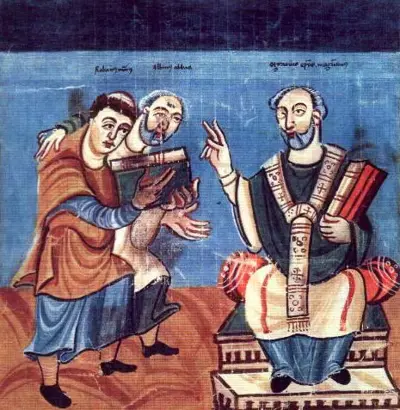
Alcuin of York – also called Ealhwine, Alhwin, or Alchoin – was an English scholar, clergyman, poet, and teacher from York, Northumbria. He was born around 735 and became the student of Archbishop Ecgbert at York. At the invitation of Charlemagne, he became a leading scholar and teacher at the Carolingian court, where he remained a figure in the 780s and 790s. "The most learned man anywhere to be found", according to Einhard's Life of Charlemagne (c. 817–833), he is considered among the most important intellectual architects of the Carolingian Renaissance. Among his pupils were many of the dominant intellectuals of the Carolingian era.
