Gelasius I Quotes
Two there are, august emperor, by which this world is chiefly ruled, the sacred authority of the priesthood and the royal power... In the order of religion, in matters concerning the reception and right administration of the heavenly sacraments, you ought to submit yourself rather than rule... The bishops themselves, recognizing that the imperial office was conferred on you by divine disposition, obey your laws so far as the sphere of public order is concerned.
This concept of separation of church and state divided the society into two domains and had the Emperor rule and the church, the other.
Gelasius I, ?-496, Roman Catholic Pope, Letter to the Emperor Anastasius, 494
Sourced by: Eigen's Political and Historical Quotations


Although James’ mother, Mary Queen of Scots had been a Catholic, James was a fervent Protestant. However, he found the separation of the State from authority over the church and the Presbyterian approach not to his liking. Also, the early tradition of the Presbyterian preachers scolding the monarch, especially his mother, was uncomfortable for James.


The letter was written at the behest of the Archbishop of Canterbury. The quotation appears to ratify the Pope’s unlimited power, but in actuality carves out an exception whereby the Pope’s authority might be challenged in the future. Specifically, it claims the Pope has not the authority to alter that which “by the word of God, has eternal validity.” Politically, this position put the pope in a box. By arguing against the proposition, the Pope would have to maintain that he should have the right to alter the word of God that had eternal validity which no pope wanted to state. By not challenging the doctrine, there was an opening by which the pope’s omnipotence could be challenged in the future.

This notice of Excommunication was promulgated to the Catholic clergy in Ireland in May of 1538. It required all Roman Catholic leaders to size the property of Protestants or Catholics who sympathized with them. Those who did were then regarded as traitors by the Protestant King. The anti-Protestant feeling culminated with the massacre of about 100 Protestants who were drowned in Bann a few years later.

There was a continuing power struggle between the more powerful kings of Europe and the Roman Catholic Pope. This struggle however was not one of church and state. Neither the kings nor the clergy viewed the two as separate domains. Instead they saw the two in much the same way as the ancient Jews and many contemporary Muslims view relationship—as an inseparable amalgam. However there was much debate over who could best protect and manage the amalgamated entity. In this case Alcuin was arguing that Charlemagne could ensure the well-being of the church better than the Pope. The power struggle went on for centuries between more or less able, powerful, and corrupt kings and popes.


What Alcuin did not say was that Charlemagne had the largest and most powerful army.


Basil the Great


While he did not believe that clerics should engage in politics, he did believe that Islamic values and law should be embodied in the nation’s constitution and laws.
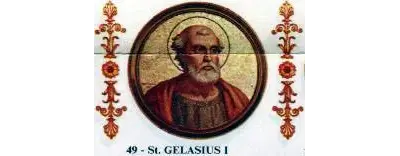
Pope Gelasius I was the bishop of Rome from 1 March AD 492 to his death on 19 November 496. He was probably the third and final bishop of Rome of Berber descent. Gelasius was a prolific author whose style placed him on the cusp between Late Antiquity and the Early Middle Ages. His predecessor Felix III employed him especially in drafting papal documents. During his pontificate he called for strict Catholic orthodoxy, more assertively demanded obedience to papal authority, and, consequently, increased the tension between the Western and Eastern Churches.
