Alcuin Quotes
You are more noble in your wisdom. You are more awe inspiring in the dignity of your kingdom. The well-being of the churches of Christ rests on you alone.
There was a continuing power struggle between the more powerful kings of Europe and the Roman Catholic Pope. This struggle however was not one of church and state. Neither the kings nor the clergy viewed the two as separate domains. Instead they saw the two in much the same way as the ancient Jews and many contemporary Muslims view relationship—as an inseparable amalgam. However there was much debate over who could best protect and manage the amalgamated entity. In this case Alcuin was arguing that Charlemagne could ensure the well-being of the church better than the Pope. The power struggle went on for centuries between more or less able, powerful, and corrupt kings and popes.
Alcuin [Flaccus] of York, ~735-804, English Scholar & Abbot, Advisor and Assistant to Charlemagne, Advice to Charlemagne regarding his role relative to that of the Pope
Sourced by: Eigen's Political and Historical Quotations

The King assumed the role of head of the Church of England.


What Alcuin did not say was that Charlemagne had the largest and most powerful army.


The telegram was sent in the name of the Irish Cabinet of the new government. This quotation shows the unique relationship that the Irish Republic has had with the Catholic Church. There was probably no other non Muslim country in the world where a political leaders could get elected avowing this kind of loyalty and control by a religious hierarchy. See {639725} for the Irish leader’s drastic departure from the concept of separation of church and state.


His positions presaged some of those of Protestants in the Reformation. In the great struggle of the time between the Pope and the Emperor, Marsilius was the leading advocate for the emperor’s superiority of authority. The Pope wrote a condemnation of these ideas.

Bush made religion a driver of his Presidency and policies in a way far in excess of other American Presidents. See {633550}. There has always been some debate as to whether he actually believed that or he was just saying it to pander to the religious conservatives who formed an important component of his base.


Justinian, like many civil political leaders before and after him, took great pains to minimize the civil authority of the church. Separation of church and state is not a modern notion, though it was harder to accomplish in antiquity. Rulers would want to coopt the religion to help legitimize their rule, but tried to keep the church as weak as they could unless another religion was challenging for supremecy.

The letter was written at the behest of the Archbishop of Canterbury. The quotation appears to ratify the Pope’s unlimited power, but in actuality carves out an exception whereby the Pope’s authority might be challenged in the future. Specifically, it claims the Pope has not the authority to alter that which “by the word of God, has eternal validity.” Politically, this position put the pope in a box. By arguing against the proposition, the Pope would have to maintain that he should have the right to alter the word of God that had eternal validity which no pope wanted to state. By not challenging the doctrine, there was an opening by which the pope’s omnipotence could be challenged in the future.


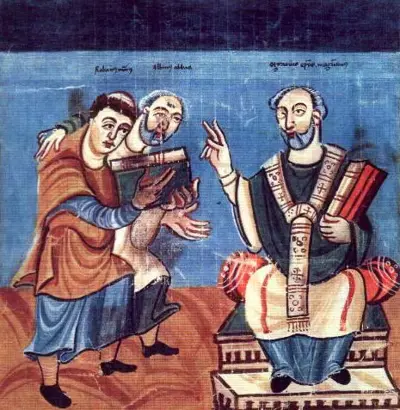
Alcuin of York – also called Ealhwine, Alhwin, or Alchoin – was an English scholar, clergyman, poet, and teacher from York, Northumbria. He was born around 735 and became the student of Archbishop Ecgbert at York. At the invitation of Charlemagne, he became a leading scholar and teacher at the Carolingian court, where he remained a figure in the 780s and 790s. "The most learned man anywhere to be found", according to Einhard's Life of Charlemagne (c. 817–833), he is considered among the most important intellectual architects of the Carolingian Renaissance. Among his pupils were many of the dominant intellectuals of the Carolingian era.
