Gelasius I Quotes
Although you take precedence over all mankind in dignity, nevertheless you piously bow the neck to those who have charge of divine affairs and seek from them the means of your salvation.
Gelasius I, ?- 496, Roman Catholic Pope, Statement to Byzantine Emperor Anastasius I
Sourced by: Eigen's Political and Historical Quotations


There was a continuing power struggle between the more powerful kings of Europe and the Roman Catholic Pope. This struggle however was not one of church and state. Neither the kings nor the clergy viewed the two as separate domains. Instead they saw the two in much the same way as the ancient Jews and many contemporary Muslims view relationship—as an inseparable amalgam. However there was much debate over who could best protect and manage the amalgamated entity. In this case Alcuin was arguing that Charlemagne could ensure the well-being of the church better than the Pope. The power struggle went on for centuries between more or less able, powerful, and corrupt kings and popes.

The Roman Catholic Church then maintained that salvation was dependent upon obedience to the Pope in all things civil and religious. See {595166} for the way that the Church at the time allowed some authority to civil authorities.


This quotation, 500 years later, would be used by American anti-Catholics to justify their antipathy to the Catholic Church. This was about a most undemocratic statement about the common man and his capabilities which was completely counter to the American view. The fact that it was 500 years past or that many American Catholics did not believe it or that even if they did, it was restricted to matters of theological faith, was not considered by the Know-Nothings and others.

This passage was one of those used by Christian apologists for slavery. Critics of some Christian churches point to this passage as illustrating the lack of morality in traditional Christianity when it same to fundamentals such as human slavery. In this particular quotation, the slave master is likened to Christ. Ironically, it was Christian abolitionists in England and the United States who saw other passages of the New Testament and the Gospel of Christ as disapproving of slavery and those Christians where among the most effective of the abolitionists.


This verse has been one of the bases of Muslim theocratic states like Iran’s claim to legitimacy.

At the time, the chief executive of these states were called Presidents because they presided over the legislature as well. This proclamation was issued before the Constitutional Convention in 1787 and the later ratification separating church and state. However, even after the Constitution was ratified some states continued to use state law to enforce the Christian Sabbath. That practice would continue in some places until the 2nd half of the 20th century.
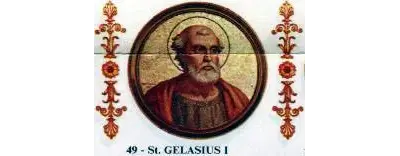
Pope Gelasius I was the bishop of Rome from 1 March AD 492 to his death on 19 November 496. He was probably the third and final bishop of Rome of Berber descent. Gelasius was a prolific author whose style placed him on the cusp between Late Antiquity and the Early Middle Ages. His predecessor Felix III employed him especially in drafting papal documents. During his pontificate he called for strict Catholic orthodoxy, more assertively demanded obedience to papal authority, and, consequently, increased the tension between the Western and Eastern Churches.
