Pope Francis Quotes
Heads of the Church have often been narcissists, flattered and thrilled by their courtiers. The court is the leprosy of the Papacy … This Vatican-centered vision neglects the world around it and I will do everything to change it.
Jorge Mario Bergoglio
Francis, Pope of the Roman Catholic Church, Quoted on PBS Frontline: Inside the Vatican, February 2014
Sourced by: Eigen's Political and Historical Quotations


The letter was written at the behest of the Archbishop of Canterbury. The quotation appears to ratify the Pope’s unlimited power, but in actuality carves out an exception whereby the Pope’s authority might be challenged in the future. Specifically, it claims the Pope has not the authority to alter that which “by the word of God, has eternal validity.” Politically, this position put the pope in a box. By arguing against the proposition, the Pope would have to maintain that he should have the right to alter the word of God that had eternal validity which no pope wanted to state. By not challenging the doctrine, there was an opening by which the pope’s omnipotence could be challenged in the future.


His response was to being asked whether he could do something with Russian Catholics to help Laval win favor with the Pope, to counter the increasing threat of Nazism. This quotation is often used as an example of Stalin’s disrespect for the Papacy. However, in this case, the Pope was extremely weak politically and some argue spiritually for he did not oppose Hitler and the Nazis very much. Defenders of the Papacy argue that Hitler had overwhelming force and little respect for the Pope, and ironically this was what Stain was referring to. Ironically, another Pope, John Paul, had a major part in bring down the Soviet Union and he had no divisions.


The Roman Catholic Church then maintained that salvation was dependent upon obedience to the Pope in all things civil and religious. See {595166} for the way that the Church at the time allowed some authority to civil authorities.


The Vatican & the Chinese Communist Government had been at odds for years with much of the Chinese church going underground. Fr. Jin had been jailed for a decade. Then the government allowed him and the Catholic Church and operate openly, but there were still Vatican conflicts over numerous issues including the right of the Government to approve senior appointments of church officials—a privilege the church claimed exclusively. The Vatican ordered Jin not to cooperate and especially not to reopen the national theological seminary which the government had ordered closed. There had been no training for Chinese priests and Jin wanted to reopen the national theological seminary but the Vatican refused cooperation waiting for the government to capitulate to the Vatican’s various demands. Fr. Jin defied the Vatican & reopened the seminary. Without officially admitting their failed tactics, the Vatican let the discipline issue against Jin drop & the national theological seminary thrived.


He was greatly concerned that if the Pope were allowed to stay in the Vatican, he would again seek temporal power which was what the revolution was all about.

The relationship between Irish Catholics and the organized priesthood has at times been contentious. Forced tithing to support clergy in a lifestyle that was greater than average, together with some corrupt priests and monks produced hostility from even many Catholics.

Of all the Western Colonial Powers, Spain was the worst. They took the most from their possessions and contributed the least. Worst, they killed off almost all the indigenous people.

The Christian Roman Empire was split in two—a Western (Latin) Empire led by the Roman Catholic Church in Rome, and the Eastern (Greek) Roman Empire led by the Orthodox Church headquartered in Constantinople (Byzantium). The two churches were not only in a theological conflict but violence broke out and the armies of the two religious empires attacked each other now and then. In 1439, leaders of the two versions of Christianity met in Florence, and they agreed to reunuion in which the Eastern Orthodox would again acknowledge the authority of the Pope. This was not a popular agreement with the majority of the Eastern Orthodox people and some of the clerical leadership. Constantine, realizing that he did not have pubic support at home for the end to the schism and the acceptance of the authority of the Pope, kept stalling on officially announcing and implementing the unity treaty. The Pope’s patience was wearing thin. Constantine did not adhere to ther treaty and the two churches have been apart ever since.


The monetary corruption of the Church and many of its priests did not go unchallenged by Catholics of the day.
The King had earlier replaced the Pope as the head of the English church. The references to money referred to a then common corruption of the Church whereby people could buy indulgences—religious papal pardons of past or future sins. This was a major revenue source for the Vatican and a major issue for Martin Luther and the Protestant Reformers some of who saw the pope as the Devil incarnate See {623153}. For Martin Luther’s view pf the practice and {626720}, {595195}, and {639436} for other contemporary views.

What Alcuin did not say was that Charlemagne had the largest and most powerful army.


Wycliffe, although a Roman Catholic, was an early reformist. He not only opposed the Pope vis a vis King Edward of England, but he went against church doctrine and printed the first English Bible. He was burned at the stake.
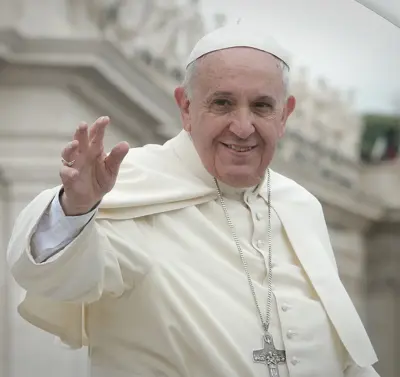
Pope Francis is the head of the Catholic Church and sovereign of the Vatican City State. Francis is the first pope to be a member of the Society of Jesus, the first from the Americas, the first from the Southern Hemisphere, and the first pope from outside Europe since Gregory III, a Syrian who reigned in the 8th century.
