Queen Victoria Quotes
... whereas hostilities have unhappily commenced between the Government of the United States of America and certain States styling themselves the Confederate States of America: .... we do hereby strictly charge and command all our loving subjects to observe a strict neutrality in and during the aforesaid hostilities, and to abstain from violating or contravening either the laws and statutes of the realm in this behalf or the law of nations in relation thereto, as they will answer to the contrary at their peril.
Queen Victoria
Victoria Alexandrina, 1819-1901, , Queen of Great Britain and Ireland & Empress of India, Proclamation of English Neutrality in the American Civil War, May 13, 1861
Sourced by: Eigen's Political and Historical Quotations

"Imperium" is a Latin word which, in a broad sense, translates roughly as 'power to command'. In ancient Rome, different kinds of power or authority were distinguished by different terms "Imperium" referred to the sovereignty of the state over the individual—Wikipedia. The Consul was a wonderful diplomat. He had no respect for the South not only because they were fighting to maintain slavery, but also he found most of their diplomats and officials very incompetent. He found it hard to participate in all the Confederate ceremonies as he was their exhibit number one that they had International Recognition and they "exhibited him frequently. Despite this he was charming and never argumentative about slavery or other political positions that he loathed. As a matter of fact, the Southern Diplomats regarded him as a man sympathetic to the South with an understanding of their point of view. As a result he gained a huge amount of intelligence which he regularly dispatched back to London. England was neutral {35520} in the Civil War, but England did not recognize the Confederacy as a nation, else they would have sent an ambassador. The Southern politicians worked hard to get him to carry their message that if they would be recognized, they would grant England many favorable trade advantages as the English textile industry really wanted Southern cotton. While apparently sympathetic to the Southern cause, his reports contained all the negative information about the South and counseled against recognition just as the English Ambassador in Washington did—see {583131}.

1st Earl of Kingston. Foreign Minister at this time. This decision was a terrible blow to the South who had been trying desperately to obtain diplomatic recognition for the Confederacy from England and other world powers.

There was some fear in the North that the shots fired by the Southern rebels, might encourage one or more of the European Powers to start a war with the United States. And if the Rebellion turned into a full scale Civil War, the South would surely encourage such acts be promising trade concessions in the export of Southern cotton. Seward’s confident and bellicose statement distressed some Union colleagues who feared that Seward might anger and provoke one of more of the machismo and nationalistic European Powers. However, if Seward was bluffing, the bluff worked. No country encroached on American interests during the Civil War. If he was not bluffing, he certainly, along with many others, understated the difficulty that the North would have putting down the Southern rebellion.


The English were at War with Napoleon and Denmark was neutral. British leaders feared that Denmark might either ally themselves with Napoleon or provide him with ships from their well equipped fleet. The English decided on a preemptive attack on Denmark and Paget and other Captains were ordered to Denmark. When they arrived they were ordered to bombard Copenhagen and force the Danes to surrender. When this happened, the British seized the Danish ships and simply took them as war prizes. The issues of the morality and wisdom of preemptive attacks, as with the Americans in the Iraq war, was thoroughly debated but the government view prevailed to the shame of most Englishmen.

Committee of the Congress. This was the prevailing Congressional and public view except for the South which had coalesced around an intellectual rationalization. See {618013}.

Charles Wilkes, a Union Navy Captain enforcing the naval blockade of the South, intercepted a British mail ship in the Caribbean and discovered two Confederate diplomats on board. He took them into custody to the cheers of Congress. England, however, was outraged that passengers—diplomats—on one of their ships was seized after boarding. This was technically an act of war. Abraham Lincoln, to the distress of many in Congress ordered the Confederate diplomats released explaining with this quotation.


While Douglas and Lincoln were political opponents with little love lost between them, both were patriots. Douglas’s position were much more popular in the South, and the moment he realized that Lincoln would win the Presidency, he headed South where he was very persuasive in trying to hold the Union together, but he could not see all the potential rebels and was only effective with some. South Carolina not only seceded, but in order to prevent any changing of minds, some the worst of the South Carolinians, attacked Fort Sumter firing on the American Flag and attacking and capturing the Union troops who were totally outnumbered. The Civil War was then inevitable.

Britain was mired in Iraq. They had, as the U. S. would do about 80 years later, gone into Iraq without a viable exist strategy.
At the time his Vice President, John C. Calhoun, was expounding a theory of “nullification” by which the states could supersede and nullify federal law in their states. When Jackson finished his toast, it was Calhoun’s turn (See {635896}.) His toast supported the States’ Rights position over the federal government. In those days Presidents and Vice President’s were often political enemies or of opposite parties. The President’s advisors thought that his toast might be misinterpreted. So when they gave the toast to the press as “The Federal Union: It must be preserved.” That was the form in which the press reported the President’s toast and for many years that was the version most quoted even though it was never delivered that way. However Jackson was responsible for both versions.
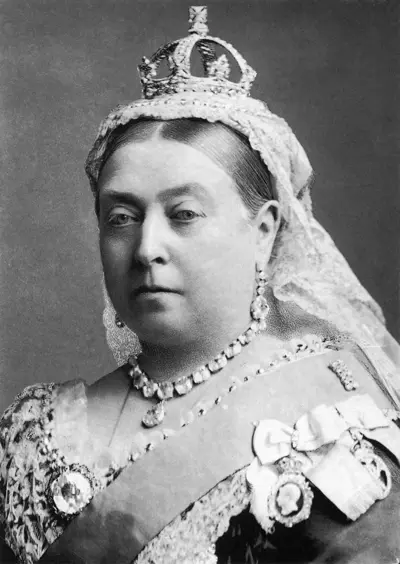
- Born: May 24, 1819
- Died: January 22, 1901
- Nationality: British
- Profession: Royalty
Victoria was Queen of the United Kingdom of Great Britain and Ireland from 20 June 1837 until her death in 1901. Known as the Victorian era, her reign of 63 years and seven months was the longest of any British monarch until surpassed by that of Elizabeth II. It was a period of industrial, political, scientific, and military change within the United Kingdom, and was marked by a great expansion of the British Empire. In 1876, Parliament voted to grant her the additional title of Empress of India.
