George III Quotes
America must be a colony of England or treated as an enemy.
George III, 1683-1760, King of England, Letter to Lord Dartmouth, June 10, 1775
Sourced by: Eigen's Political and Historical Quotations


Americans were by no means united in wanting to take up arms against Britain. Relatively few of the loyalist quotations have come down to us, but here is one. It also illustrates why some Americans wanted complete independence: So that they could escape their debts to English merchants. Most however had more noble and unselfish motives. As a matter of fact, the American Revolution is unusual in the sense that there were so many men of substance who sacrificed much of their material wealth for the American ideal. There were also the rogues and opportunists as Galloway describes.


Because the early nation's government was still in a state of becoming, foreign powers were hesitant to do business and conclude treaties with the newly-formed United States of America:

Les Américains ont échappé à l'Angleterre.

The document was signed in his name by his ministers.


The message was conveyed by the Secretary of State, Sir George Calvert (Lord Baltimore). Parliament and the British King were jockeying for position in their relative powers. King James took the position that Parliament could NOT make laws that affected the American Colonies. Parliament disagreed. Later, some of the American patriots would use this quotation to claim that they were only subject to the King and not to Parliament. For related quotes on the King/Parliament issue, see {639144}, {639143}, {639142}, {639141}, {639140}, & {639137}


Fox was one of the opposition leaders who were opposed to the heavy handed policies that the British King and Government had used.
This was written more than a year before the “blows” began. It took time to ship the men and supplies to America and the British did not handle that task with much efficiency.

This was a last attempt to avoid war. Lord Howe met with William Rutledge, John Adams and Benjamin Franklin. The discussions were civil and Howe wanted to avoid a conflict but he did not have the authority to accept the American colonists demand for independence.

This resolution was the trigger that began the debate which became the Declaration of Independence.

Hobson, like Mark Twain in America, was a major critic of imperialism.

The “proofs” were diplomatic assurances—treaties—that England would guarantee the territorial integrity of Belgium. The British made strong diplomatic efforts to persuade Germany not to occupy Belgium. The German’s none the less send armies in under the excuse that if they did not, the French would occupy the country and have a strategic advantage over them. Diplomacy could do no more good. England had to send troops or renege on its obligations. So England was in WWI.

The professor was lecturing to British university students about 75 years after the American Revolution. The “American War” is the term the British use for the American Revolution.

Earlier, his father had also castigated the ministers over their inept hard-line handling of the American Revolution. See {641505} .

Chamberlain’s policy was to appease Hitler and Germany to avoid war. Although he did not see Czechoslavkia as a critical British national interest and claimed he had secured peace {585941} , the reality was that he gave Germany room to start its aggression which would engulf all of Europe and much of the world. The British became the only bulwark against Hitler until the Russians stopped the Germans and America entered the war.

This is the same man who introduced the Stamp Act 12 years before which started the whole problem in America. See {74956}.


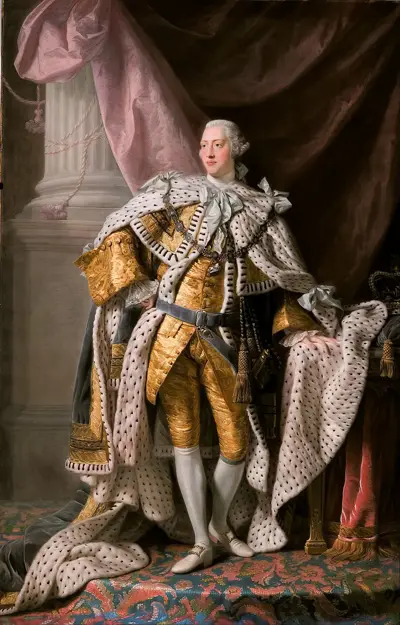
George III was King of Great Britain and Ireland from 25 October 1760 until the union of the two kingdoms on 1 January 1801, after which he was King of the United Kingdom of Great Britain and Ireland until his death in 1820. He was concurrently Duke and Prince-elector of Brunswick-Lüneburg ("Hanover") in the Holy Roman Empire before becoming King of Hanover on 12 October 1814. He was a monarch of the House of Hanover, but unlike his two predecessors, he was born in Great Britain, spoke English as his first language, and never visited Hanover.
