George III Quotes
The New England Governments are in a state of rebellion; blows must decide they are to be subjects of this country or independent.
This was written more than a year before the “blows” began. It took time to ship the men and supplies to America and the British did not handle that task with much efficiency.
George III, 1683-1760, King of England, Letter to Lord North, November 18, 1774
Sourced by: Eigen's Political and Historical Quotations


Fox was one of the opposition leaders who were opposed to the heavy handed policies that the British King and Government had used.

While the official battles of the American Revolution did not begin until 1776, parts of the American colonies were in a de facto state of rebellion and the British could not enforce their laws. See {636925} for another of the King’s statements.


This was written more than a year before the American Revolution Battles began. It took time to ship the men and supplies to America and the British did not handle that task with much efficiency. See {636926} for another of the King’s statements.

He was arrested and renditioned to Pakistan a few hours later. Nonetheless, the secession succeeded and Bangladesh became an independent country.

While Adams was a little hyperbolic in his claim, the vast majority of the colonists who were protesting British policy and administration in 1775 were seeking reform, not separation from England. But what a difference a year made! British reaction radically changed the objectives of most colonists. See George Washington {613171} for a similar view.
This quotation shows that the dissent leading to the American Revolution did not emerge suddenly in 1776 after the Battle of Bunker Hill. Dissent, sedition and even violence was documented here in 1774. Salem at the time was the second largest port in the colony and the customs tax collectors—Loyalist Americans—were run out of Salem.

Several years before the Battle of Bunker Hill, revolutionary activity had already broken out in the American colonies—See {634132} for an example. This law gave the British authorities much more “clout” in dealing with the “seditious” American activities. It protected English law enforcement officials from being tried in local Colonial courts for murder or assault in putting down insurrections. George Washington and other Patriots were outraged over this law. See {634131}.

This resolution was the trigger that began the debate which became the Declaration of Independence.


In one of the most unusual revolutions in world history, Brazil became independent from Portugal via a revolution led by the son of the Portuguese King and heir to the throne, Pedro I. Ironically the King of Portugal, John VI, in this famous quote, encouraged his son to lead the revolution. There were strong separatist sentiment in Brazil and the King thought it would be better to have an independent Brazil lead by a member of his family.
The simplistic view that the American colonists were patriots and the British were the colonizers against whom the colonists revolted is not really accurate. The American colonists were polarized into patriots and loyalists. The Loyalist Americans ranged from many of those merchants whose business depended upon England, those whose family were still in England, those whose religion made them loyal to the Church of England, slaves who would be free under British law, Americans who had strong cultural and intellectual ties to England and those Americans who were great believers in monarchy and whose honor required that they fulfill the oath that they had taken to the King of England. Some of the worst atrocities of the American Revolution occurred in the battles of these Americans against each other. See {82105} for more on this point.

He was acting as French Foreign Secretary at the time.


2nd Earl of Guilford. This bill cut off all trade with the American Colonies. It was meant as pressure to cease the rebellion. It did not work.


The treaty ending the Revolutionary war guaranteed that the English bankers and merchants who had debts going back to before the American Revo
lution would have “no impediment” in collecting their debts in America. However, Rhode Island and Virginia in particular placed many impediments and made it virtually impossible for debts to be collected in their states. The John Jay led Supreme Court, in particular, overturned state actions on the grounds that they had implemented Patrick Henry’s sentiment and hence violated the treaty.

This resolution of independence was voted upon a month before the Declaration of Independence. It was approved by 12 of the colonies but not by New York. The Congress appointed a committee to draft what became the Declaration of Independence and that was approved by all the colonies. The resolution was introduced by Richard Henry Lee on instructions from Virginia. The graphic is of Lee’s original notes.

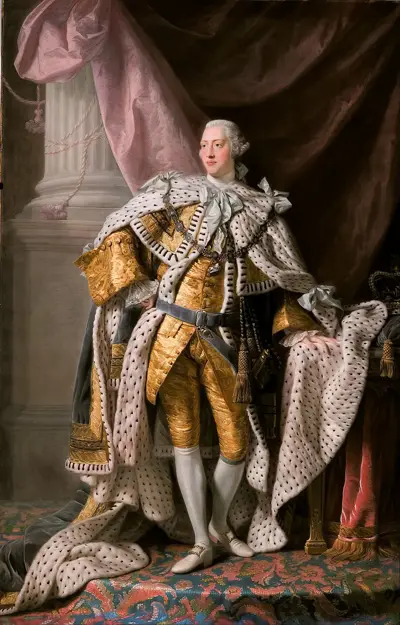
George III was King of Great Britain and Ireland from 25 October 1760 until the union of the two kingdoms on 1 January 1801, after which he was King of the United Kingdom of Great Britain and Ireland until his death in 1820. He was concurrently Duke and Prince-elector of Brunswick-Lüneburg ("Hanover") in the Holy Roman Empire before becoming King of Hanover on 12 October 1814. He was a monarch of the House of Hanover, but unlike his two predecessors, he was born in Great Britain, spoke English as his first language, and never visited Hanover.
