Joseph Galloway Quotes
… persons, whose design, from the beginning of their opposition to the Stamp Act, was to throw off all subordination and connection with Great Britain; who meant by every fiction, falsehood and fraud, to delude the people from their due allegiance, to throw the subsisting Governments into anarchy, to incite the ignorant and vulgar to arms, and with those arms to establish American Independence --- were Congregational and Presbyterian republicans, or men of bankrupt fortunes, overwhelmed in debt to the British merchants.
Americans were by no means united in wanting to take up arms against Britain. Relatively few of the loyalist quotations have come down to us, but here is one. It also illustrates why some Americans wanted complete independence: So that they could escape their debts to English merchants. Most however had more noble and unselfish motives. As a matter of fact, the American Revolution is unusual in the sense that there were so many men of substance who sacrificed much of their material wealth for the American ideal. There were also the rogues and opportunists as Galloway describes.
Joseph Galloway, 1729–1803, Speaker, Pennsylvania House of Representatives, Pennsylvania Delegate to the Continental Congress, Loyalist opponent of the American Revolution, Speech to the Continental Congress describing those who wanted independence from England, September 28, 1774
Sourced by: Eigen's Political and Historical Quotations

The colonists in America had no representatives in Parliament. Galloway who opposed armed rebellion against Britain {621966} admitted that the British treatment of America was wrong but saw other solutions. It will never be known if any of them might have worked. The world would have been very different had they been tried.


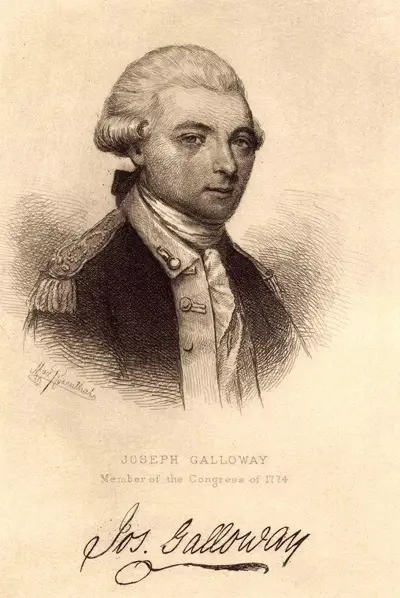
Joseph Galloway was an American politician. He became a Loyalist during the American Revolutionary War, after serving as delegate to the First Continental Congress from Pennsylvania. For much of his career in Pennsylvania politics, he was a close ally of Benjamin Franklin, and he became a leading figure in the colony. As a delegate to the Continental Congress, Galloway was a moderate and proposed a Plan of Union which would have averted a full break from Britain. When that was rejected, he moved increasingly towards Loyalism.
