William E. Gladstone Quotes
… there is no doubt that Jefferson Davis and other leaders of the South have made an Army; they are making, it appears, a Navy; and they have made — what is more than either — they have made a Nation... We may anticipate with certainty the success of the Southern States so far as regards their separation from the North.
He was Chancellor of the Exchequer at the time of this speech. Gladstone was certain about most of his views on foreign policy but correct on only some with many blunders on his watch. This view was very important for the Confederacy as it was a prerequisite to diplomatic recognition. The latter never came.
William E. Gladstone, 1809-1898, British Prime Minister (Liberal), Speech, Newcastle, October 7, 1862
Sourced by: Eigen's Political and Historical Quotations

This was a decade before there was a Civil War. Secession and war had been advocated by many Southerners for years before. Most people are not aware that the move toward secession did not suddenly appear when Lincoln was elected President. It had been festering for over a decade. The other importance of the quotation is that the Southernors knew perfectly well that their actions would lead to a civil war. Some Southern apologists claim that the South never saw their actions as treason, rebellion or the cause of a civil war. This quote shows that they well knew what they were doing and the result was exactly as most Southern leaders expected.

The early Union military leadership was so poor and timid that it was not clearly demonstrated that a Confederacy was not viable until later in the war, and the Southerners possessed an extraordinary capacity for ignoring reality and self-delusion, that it was not demonstrated until Grant’s major victories and Sherman’s March through Georgia and the Southern East Coast that an independent South was not going to be.

The Southern states were illegal rebels. A confederacy had always meant a voluntary association of otherwise independent entities. However technically the Southern states were not independent but in a state of illegal rebellion against the United States. Lincoln, a lawyer, could not being himself to refer to the South by their preferred name—the Confederacy. So this was how he and many in his administration referred to the South.


As just one example of Southern States' reasons, see {583044}. Many of the Northern States had passed laws declaring everyone in the state was free and making it illegal to return or assist in the returning of escaped slaves. The Southerners got the Federal Fugitive Slave Act passed which required all Americans to assist in recapturing escaped slaves. It was the Northern States who claimed states' rights were being trampled. The South was vehemently opposed to States' Rights when it came to allowing individual states to decide who was free and who was not. The Southerners had only one fundamental reason for secession—the maintenance of the Negro slavery system on which much of their economy depended as did their sociology, culture, and way of life.


The Prime Minister had a penchant for mis-assessing world affairs in both the old world and the new.


Committee of the Congress. This was the prevailing Congressional and public view except for the South which had coalesced around an intellectual rationalization. See {618013}.


Eggleston was an accomplished writer who had served in the Confederate army of the Civil War. 20 year after the war he wrote a series of articles for the prestigious Northern Atlantic Monthly trying to convey the war from the Southerner’s point of view.
It is often said that “elections have consequences”. The 1960 election was one that certainly had profound consequences. Lincoln was unwilling to force the Northern states to return fugitive slaves against the constitution, laws and will of the people of those states as Buchanan said he was (but had a hard time doing). Also Lincoln was unwilling to allow new territories to enter the union if they allowed slavery. In the end, most pro Slavery politicians realized that with the greater growth rate of the North, they Southern disproportionate power in the Congress was doomed as would be the institution of slavery itself. Crittendon a strong Unionist from a border state, understood the implication of Lincoln’s election for the Union.


Queen Victoria


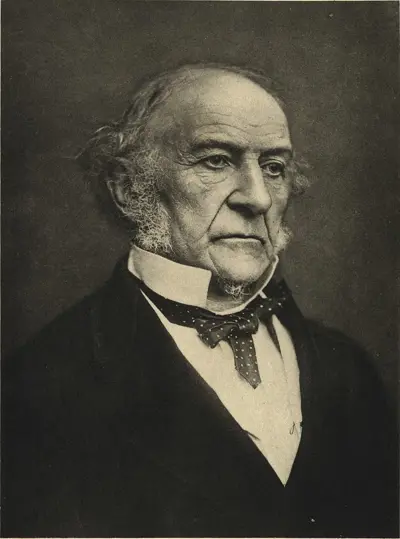
William Ewart Gladstone FRS FSS was a British statesman and Liberal politician. In a career lasting over 60 years, he served for 12 years as Prime Minister of the United Kingdom, spread over four terms beginning in 1868 and ending in 1894. He also served as Chancellor of the Exchequer four times, serving over 12 years.
