Horace Greeley Quotes
Taylor won votes in both the free and slave states by reason of his persistent and obstinate silence and reserve on the vexed question of slavery.
The nation in 1848 was very polarized over the issue of slavery. Taylor, never even mentioned the subject in his speeches and writings. He reused to answer any questions about the subject or indicate his own views. His strategy worked as the other politicians who took a stand—either way—alienated a large number of voters.
Horace Greeley, 1811-1872, Newspaper Editor & Candidate for the Liberal Republican Presidential nomination (Defeated by Grant), Explanation of Zachary Taylor’s Presidential victory in 1848
Sourced by: Eigen's Political and Historical Quotations


It is not only in modern times that there were “litmus tests” for appointees. Franklin Pierce had been elected as a Democrat with a coalition that included Southerners who were able to dominate the weak Pierce precluding abolitionists from any appointments.

In modern times, many have complained at the disrespectful way critics refer to the president of the United States. The long for the civility of the past. As this editorial shows, uncivil criticism of the president is nothing new.


As just one example of Southern States' reasons, see {583044}. Many of the Northern States had passed laws declaring everyone in the state was free and making it illegal to return or assist in the returning of escaped slaves. The Southerners got the Federal Fugitive Slave Act passed which required all Americans to assist in recapturing escaped slaves. It was the Northern States who claimed states' rights were being trampled. The South was vehemently opposed to States' Rights when it came to allowing individual states to decide who was free and who was not. The Southerners had only one fundamental reason for secession—the maintenance of the Negro slavery system on which much of their economy depended as did their sociology, culture, and way of life.


The Mystery was for many years the only Black Newspaper in America.

The issue is whether Kansas would enter the Union as a slave state of a free state. If a free state, the free states would be able to block further slavery. If Kansas were to become a slave state, the slave states would have a sufficient majority to make all future expansion hospitable to slavery. The slavery forces started sending man and families into Kansas so that they could vote; the abolitionists did the same. Both sides armed and a war began with each faction trying to kill or drive the other faction out of Kansas before the vote. See {49978} for the pro-slavery view of Kansas

The problem was that Congress was gridlocked on the slavery issue. The Southern states had more than their proportional share of Congressional power with slave populations being counted as 3/5 of a person for seats in the House of Representatives and parity with the other states in the Senate. The South could not stop all the attempts to debate slavery and the abolitionists attempts to end it, but they could block all legislation that might curtain slavery. As the United States was getting more sophisticated and educated hostility toward slavery was steadily increasing. The economies of the non Southern states was growing faster and more assuredly than the slave economies of the South. Abolition was all but inevitable but it would still take more time. Note that the President totally deferred to Congress on the leadership of what the policy should be. Presidents at that time were far less influential in making national policy and national legislating than they have become. Many think that the balance has shifted too far towards the Executive Branch.

Some Southerners, in order to obtain support in England for the Confederate cause claimed in their propaganda that slavery was not the issue but their issue with the Union was just one of local and regional autonomy. The British and most Europeans at that time were strongly against slavery so this “spin” might have gotten some support. Stowe and others put the lie to this, and the Confederacy never did get any significant material support from any country in Europe. The secession resolutions of the Southern States all state that Slavery was the cause (and often the ONLY cause stated) of secession. Also Southern General Mosby, called the spin for what it was. See {584991}.

Buchanan us considered by most historians to have been the worst or one of the worst Presidents of the United States. At this point, he was a lame duck president with Abraham Lincoln, the President Elect soon to take office. This speech, just encouraged the South more than ever and helped to bring about the Civil War. His vacillation and lack of any leadership on the slavery question exacerbated the polarization that was tearing the nation apart.

And so they were. However, Calhoun had already concluded which alternatives the South would take. See {635930}

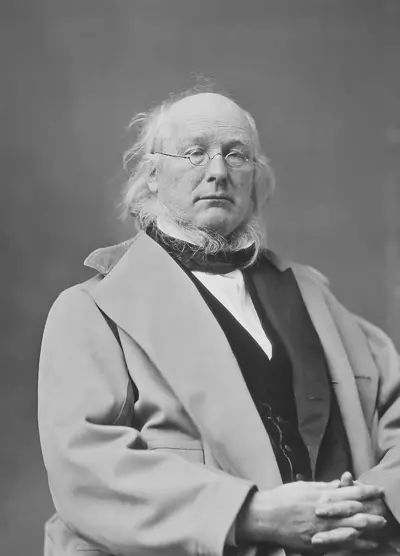
Horace Greeley was an American newspaper editor and publisher who was the founder and editor of the New-York Tribune. Long active in politics, he served briefly as a congressman from New York, and was the unsuccessful candidate of the new Liberal Republican Party in the 1872 presidential election against incumbent President Ulysses S. Grant, who won by a landslide.
