Stephen Douglas Quotes
You cannot limit this country by boundary lines.
Stephen Douglas, 1813-1861, U. S. Congressman & U. S. Senator (Democrat, IL), 2nd Lincoln-Douglas Debate, Freeport, IL, August 27, 1858
Sourced by: Eigen's Political and Historical Quotations

This phrase was originally an ancient Roman one: A mari usque ad mare.


At the time the Algerians leading the impendence movement were very secular, and were committed to modernity, multiculturalism and religious freedom and tolerance. Within Algerian Muslim society, there has been a constant battle against the right wing Islamic extremists and terrorists.


Ingersoll was considered to be the greatest orator and political thinker of his day, but his overt atheistic views curtailed his elected political career.


The motto was worn on their uniforms which unlike the blue of the rest of the American army was white as can be seen in the famous paining by muralist David R. Wagner. Rhode Island offered freedom to all slaves who would enlist. It not only included Negroes but Indian slaves as well. See {613949} and {614120} for details. The motto itself is interesting in that there was little concept of a country then as most Americans identified themselves as Virginians, New Yorkers or Rhode Islanders. There was no Constitution—only a confederation of States. But the former slaves joining the regiment had never voluntarily associated themselves with Rhode Island, and the first free decision they made was to join the regiment and have a new country.

After Independence, the original credo of the Indonesian hero and leader was slowly ignored. The Muslim majority established Islam as the dominant religion and began to create laws that discriminated against Christians, Hindus, Buddhists, and Jews. The ethnic Chinese had been very successful in business and commerce and soon they were discriminated against and even physically attacked in Pogroms.

Buchanan was the first major Republican to advocate isolationism since that was the backbone of Republican Party ideology in the decades before WWII. This was a large reversal from the Internationalism and Manifest Destiny of Republicans under Presidents McKinley and Theodore Roosevelt. After Roosevelt’s great leadership making the United States the preeminent power in the World, the Republicans also espoused that direction and even took it further than the Democrats. But Buchanan was advocating another Republican Flip Flop, and while he found little support from Republican Party regulars, he fired up a small but intense group—most;y white males who were not college graduates. These Buchanan supporters became the nucleus of the Tea Party that would come to prominence 20 years later.


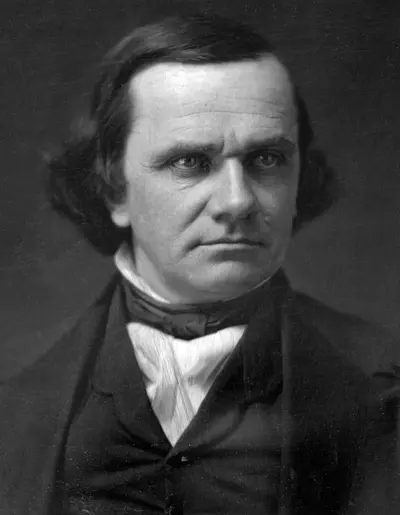
Stephen Arnold Douglas was an American politician and lawyer from Illinois. He was one of two Democratic Party nominees for president in the 1860 presidential election, which was won by Republican Abraham Lincoln. Douglas had previously defeated Lincoln in the 1858 United States Senate election in Illinois, known for the Lincoln–Douglas debates. During the 1850s, Douglas was one of the foremost advocates of popular sovereignty, which held that each territory should be allowed to determine whether to permit slavery within its borders. Douglas was nicknamed the "Little Giant" and "Stevie D" because he was short in physical stature but a forceful and dominant figure in politics.
