Stephen Douglas Quotes
Slavery is not the only question which comes up in this controversy. There is a far more important one to you, and that is, what shall be done with the free negro?
Douglas, Stephen A. "Speech of Senator Douglas, Delivered at Springfield, Ill., July 17, 1858." Political Debates Between Hon. Abraham Lincoln and Hon. Stephen A. Douglas, in the Celebrated Campaign of 1858, in Illinois. Follett, Foster and Company, 1860, p. 47.


William Z. Foster, the 1928 communist presidential candidate, was arrested because his party’s leaflet contained this “inflammatory” slogan.

Moynihan was actually not the political originator of the "benign neglect" phrase which became so controversial. It had been first used by The Earl of Durham in his 1839 Durham Report on the English policy towards Canada.


In the middle of WWII where Black soldiers were fighting and dying on the war front. Some had an expectation that they would, when they returned, would have their civil rights and an end to discrimination. Southerners did nothing but perpetuate the racist customs and laws of the South and it was not until the 1963 Civil Rights Act that there was to be major change.


This is one of the earliest public positions taken against the legal prohibition on interracial marriage. On this issue, even the vast majority of the Northerners were against her. The “commonwealth” to which she refers, is the Commonwealth of Massachusetts. Note that freedom of choice then meant the freedom to choose of marriage partners without regard to race. A century later, it became the freedom to choose the medical procedures that a woman would be subjected to.


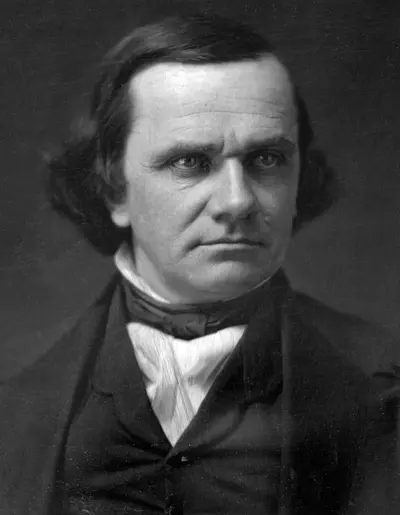
Stephen Arnold Douglas was an American politician and lawyer from Illinois. He was one of two Democratic Party nominees for president in the 1860 presidential election, which was won by Republican Abraham Lincoln. Douglas had previously defeated Lincoln in the 1858 United States Senate election in Illinois, known for the Lincoln–Douglas debates. During the 1850s, Douglas was one of the foremost advocates of popular sovereignty, which held that each territory should be allowed to determine whether to permit slavery within its borders. Douglas was nicknamed the "Little Giant" and "Stevie D" because he was short in physical stature but a forceful and dominant figure in politics.
