Andrew Johnson Quotes
… that the authority of the Government of the United States may be restored, and that peace, order and freedom may be established, I, Andrew Johnson, President of the United States, do proclaim and declare, that I hereby grant to all persons who have directly or indirectly participated in the existing rebellion, except as hereinafter excepted, amnesty and pardon, with restoration of all rights of property, except as to slaves, … but on the condition, nevertheless, that every such person shall take and subscribe to the following oath or affirmation, and thenceforward keep and maintain said oath inviolate:
For the required Oath, see {623308} . There were several to the amnesty. These included graduates of West Point and the Naval Academy who had joined the rebellion, senior officers and officials of the Confederacy, those who were accused of war crimes and abusing Union prisoners of war, persons who went abroad to help the Confederacy, and Northerners who had gone South to aid the rebellion. Many scholars think that although Lincoln had expressed his desire to provide an amnesty after the war was over, he probably would have been more lenient than Johnson who exempted many on the Southern side—especially the leaders. Ironically, Johnson was a Southerner but was personally, morally outraged at taking up arms against the United States and in that sense was much more of a hawk than Lincoln and many of the radical Republicans even. However, he was an inveterate racist and resisted most of the attempts to implement equality during the Reconstruction. Many argue that but for Johnson, Reconstruction might have been much more successful. It was easy for Southerners to resist equal rights for Blacks when they knew that the President was also opposed to measures to produce equality.
Andrew Johnson, 1808-1875, 17th President of the United States (War Democrat), May 29, 1865
Sourced by: Eigen's Political and Historical Quotations

This oath was required of Southern Rebels who wanted obtain amnesty from treason which they had committed by engaging in the Civil War. See {623307} for the Presidential Proclamation.

President Andrew Johnson had been impeached by the House of Representatives and was being tried in by the Senate. A majority of the Senators voted for conviction but the vote was 1 short of the two-thirds that were needed. Johnson remained in office. One of the major accusations against Johnson was that he had appointed Southern rebels to positions.

President Andrew Johnson had been impeached by the House of Representatives and was being tried in by the Senate. A majority of the Senators voted for conviction but the vote was 1 short of the two-thirds that were needed. Johnson remained in office.

This was one of the several early unofficial Emancipations that was issued in the Civil War.


This was the letter which triggered Lincoln’s famous reply. See {609337}.

Note that Lincoln did not justify the emancipation proclamation on moral or humanitarian grounds, but on the grounds of military necessity.


Butler was at the time the Union general in charge of Louisiana. He had on his hand a large group of slaves whose owners had abandoned the area. There was no emancipation yet. He wrote for instructions. The result was the first actual emancipation of slaves.


Lee although born in England was one of the most ardent of the patriots fighiting the British. This oath was even considered extreme at the time. He was considered a super hawk by Washington and others. He became the Senior Major General and if anything had happened to Washington he would have command. He was an extremist who thought himself far more militarily qualified than Washington. See {59589} and {55885} for two of his slights against Washington.


When the first Southern States seceded, each appointed a whose job it was to persuade the other Southern States to also secede. In this case Hale was marketing secession to Kentucky which with Maryland were the only two Southern States to reject what they regarded as treason and rebellion. The importance of the quotation however is in his argument which was all based on enmity to racial equality and abolition. Later Southern apologists would argue that the Civil War was fought, not about slavery and racism butt about different philosophies of government. See {623715} .


The British Governor was genuinely anxious to avoid bloodshed and the American Revolution. However, the conflict had been brought about by the actions of the British Parliament and the Kings ministers, and Gage did not have the power or authority to alter the issues of the fundamental conflict—taxation, colonial government, economics, self determination. While he offered pardons, in this proclamation he specifically exempted Samuel Adams and John Hancock of whom he said “whose offences are of too flagitious a nature …”
Hunton was an old West Point classmate of Sherman’s and was also a Tennessee slave holder, who wanted his escaped slaves back under the Fugitive Slave Act. Actually, Army Commander McClellan had issued an order just a few days before, prohibiting the Army of returning fugitive slaves to their rebel owners who were guilty of treason. See {619337} Sherman however wrote his friend and made a moral and ethical argument that transcended the law and at the same time pointed out the ethical hypocrisy of the treasonous Confederates.
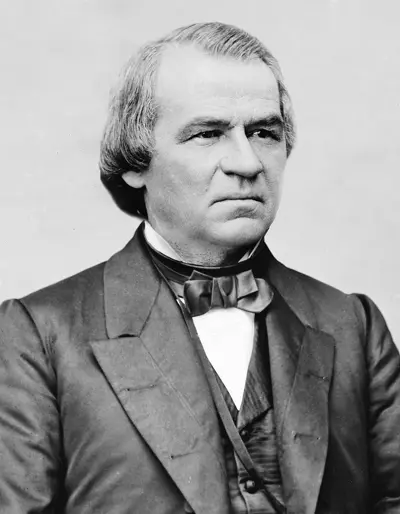
- Born: December 29, 1808
- Died: July 31, 1875
- Nationality: American
- Profession: President
Andrew Johnson was the 17th president of the United States, serving from 1865 to 1869. He assumed the presidency as he was vice president at the time of the assassination of Abraham Lincoln. Johnson was a Democrat who ran with Lincoln on the National Union ticket, coming to office as the Civil War concluded. He favored quick restoration of the seceded states to the Union without protection for the former slaves. This led to conflict with the Republican-dominated Congress, culminating in his impeachment by the House of Representatives in 1868. He was acquitted in the Senate by one vote.
