William Tecumseh Sherman Quotes
To those who submit to rightful law and authority, all gentleness and forbearance; but to the petulant secessionist … death is a mercy, and the quicker he or she is disposed of the better.
William Tecumseh Sherman, 1820-1891, General of the Army Letter during the Civil War, Quoted in The Wilson Quarterly, Summer 2011
Sourced by: Eigen's Political and Historical Quotations


Charles I had caused the death of his subjects with impunity and was called to account. However, the English Parliament did not know what specific crime the King had committed. Kings had executed people, guilty of crimes and otherwise, for centuries. For what could a king be accountable. Cooke developed the crime of Tyranny and drew up and presented the indictment for that. The King was found guilty and executed. This was the first time in legal history that a ruler was called to account for crimes committed against his own people. It became the foundation for many trials thereafter including that of Saddam Hussein in 2006.

Campbell carried out the order although many MacDonalds escaped in the highlands. The particular massacre has always taken on an even greater infamy because the Campbell murderers had been given food and hospitality by the MacDonalds. This began the most bitter of the Scottish clan feuds that persists into modern times.

government appointed officials and bureaucrats Savonarola was a very hated ruler, opposed to any kind of a Parliament or assembly. And the penalty for advocating for a Parliament was severe. The Signoria were the various government appointees and clerks. They were influential in Florence and hence they were silenced by the mot draconian methods. There was a movement throughout Italy for parliaments and less arbitrary government. Savonarola was particularly strict in his rooting out sin and cruel in his punishments and hence very unpopular. He was also under the delusion that God himself had called on him to preach his strict version of morality. Some of the Nobles reached the Pope with many of Savonarola’s extreme statements and Savonarola was excommunicated and burned as a heretic. His executioner gloated that he was burning Savonarola before the powerful priest could burn him as he had done so many others.


The revolution turned on many of its initiators including Vergniaud. He was guillotined along with other Girondists.


South Carolina passed a state law which overrode and nullified Federal Laws that they did not like. It was a type of secession. President Jackson, in his own blunt style, let them know that they had better not try to implement their nullification law. Of all the Presidents in American History, Jackson had the least respect for Constitutionality and due process. He had a history of summary execution where he was the judge, jury and almost the personal executioner. He is the only president in American history who refused to obey and order of the Supreme Court. There were few who doubted that he would make good on his threat. The South Carolina convention reconvened and repealed its Nullification Ordinance on March 11, 1833.


Secession was not a new concept just before the Civil War. Southerners had threatened in early America, not to join the Union unless they could maintain the evil of slavery. After the union and the Constitutional ratification, whenever there was any discussion of slavery attempted in the Congress, some Southerners would threaten secession.


When the Confederate Government realized that the Union was planning to arm escaped slaves and induct them into the Union Army, they quickly passed a law that declared any escaped slave who joined the Union Army or wore its uniform was guilty of Treason and would be executed. Most Union Generals one way or another got word to the Confederate Officers that they had better treat all Negro Union Soldiers as prisoners of war. Even President Lincoln warned the South. Butler, however, had a large number of Negro troops in his area and had heard threats of some of the Southerners to execute Black prisoners of war. He had a way of making things very clear, and he was able to prevent murder of any of his Negro troops despite the Treason law.

France was coming under great criticism from the rest of Europe for the bloodbath of executions that the Revolution had become. Many French thought that perhaps they were executing too many people. Saint-Just urged them to hold the course and they did.


For the required Oath, see {623308} . There were several to the amnesty. These included graduates of West Point and the Naval Academy who had joined the rebellion, senior officers and officials of the Confederacy, those who were accused of war crimes and abusing Union prisoners of war, persons who went abroad to help the Confederacy, and Northerners who had gone South to aid the rebellion. Many scholars think that although Lincoln had expressed his desire to provide an amnesty after the war was over, he probably would have been more lenient than Johnson who exempted many on the Southern side—especially the leaders. Ironically, Johnson was a Southerner but was personally, morally outraged at taking up arms against the United States and in that sense was much more of a hawk than Lincoln and many of the radical Republicans even. However, he was an inveterate racist and resisted most of the attempts to implement equality during the Reconstruction. Many argue that but for Johnson, Reconstruction might have been much more successful. It was easy for Southerners to resist equal rights for Blacks when they knew that the President was also opposed to measures to produce equality.
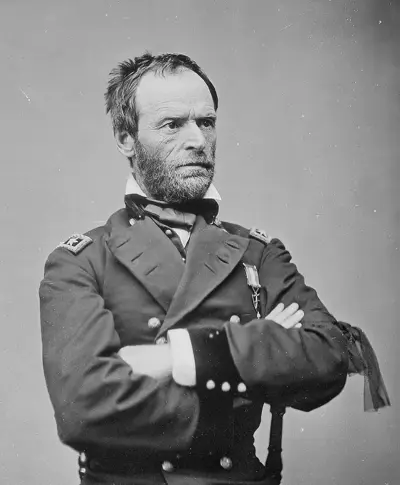
William Tecumseh Sherman was an American soldier, businessman, educator, and author. He served as a general in the Union Army during the American Civil War (1861–1865), receiving recognition for his command of military strategy as well as criticism for the harshness of the scorched earth policies he implemented in conducting total war against the Confederate States. British military theorist and historian B. H. Liddell Hart declared that Sherman was "the first modern general".
