Andrew Jackson Quotes
If one drop of blood be shed there in defiance of the laws of the United States, I will hang the first man of them I can get my hands on to the first tree I can find.
South Carolina passed a state law which overrode and nullified Federal Laws that they did not like. It was a type of secession. President Jackson, in his own blunt style, let them know that they had better not try to implement their nullification law. Of all the Presidents in American History, Jackson had the least respect for Constitutionality and due process. He had a history of summary execution where he was the judge, jury and almost the personal executioner. He is the only president in American history who refused to obey and order of the Supreme Court. There were few who doubted that he would make good on his threat. The South Carolina convention reconvened and repealed its Nullification Ordinance on March 11, 1833.
Andrew Jackson, 1767-1845, 7th President of the United States (Democrat, TN), Warning to the South Carolina Nullification Activists, 1833
Sourced by: Eigen's Political and Historical Quotations


In the related quote, Jackson makes the case against the South Carolina argument for nullification. Here he makes his threat which was very successful in ending the notion of “nullification”. The extensive quotation is given as it summarizes the entire issue that was one of the crises of early America.


Jackson makes the case against the South Carolina argument for nullification. In the related quote, he makes his threat which was very successful in ending the notion of “nullification”. The extensive quotation is given as it summarizes the entire issue that was one of the crises of early America.

The South had a tradition of lynching even before Reconstructon. Southern Leaders like Jefferson encouraged and justified the heinous practice. In the West there was a good bit of vigilantism justified by the fact that there was no functioning legal system and few law enforcement officers. But Jefferson and many other Southerners, although there was a law enforcement system except in the most rural areas, advocated lynching as a combination of vengeance and other emotions that are hard to identify.


This has been the case in EVERY jurisdiction that has had capital punishment. Capital punishment does provide vengeance for victims, relatives and society. And in many societies execution is less expensive than prison for life. But it has never curtailed crime despite the example. In London, they used to have public executions as examples to inhibit crime. While the crowd was watching a pickpocket be hung, other pickpockets were relieving many spectators of their wallets and watches.


Romulus Whitaker personally killed his brother.


government appointed officials and bureaucrats Savonarola was a very hated ruler, opposed to any kind of a Parliament or assembly. And the penalty for advocating for a Parliament was severe. The Signoria were the various government appointees and clerks. They were influential in Florence and hence they were silenced by the mot draconian methods. There was a movement throughout Italy for parliaments and less arbitrary government. Savonarola was particularly strict in his rooting out sin and cruel in his punishments and hence very unpopular. He was also under the delusion that God himself had called on him to preach his strict version of morality. Some of the Nobles reached the Pope with many of Savonarola’s extreme statements and Savonarola was excommunicated and burned as a heretic. His executioner gloated that he was burning Savonarola before the powerful priest could burn him as he had done so many others.


The revolution turned on many of its initiators including Vergniaud. He was guillotined along with other Girondists.

The choice is usually contrasted between guilty persons going free, rather an innocent one be adjudicated guilty. But here the justice tells us that the avoidance of an innocent person being subject to easy arrest is important enough to have a system where guilty people sometimes escape justice.


Americans are divided as to whether this should be encouraged and helped or not.


In his early career, her supported capital punishment, but changed his mind as can be seen in this quotation.

Vladimir Lenin. At the time of the Russian Revolution, the country was a mess for all except the very rich and the nobles. Food was very scarce and speculators would buy up food and hoard it driving the price way up while some people starved. Bandits were active throughout the country stealing anything at gunpoint so that they could buy food. Meanwhile the country had been at war with Germany and the previous law enforcement was the Czar’s’ police who were now overthrown and there were no law enforcement officers in most places. Much of the nation was in chaos. Lenin and others urged extreme measures which were used to stabilize things at a horrendous cost in human rights and human life. Many Russians were shot, having been unjustly accused by people settling scores. Terror meant the act of terrorizing people in order to get them to behave in a certain way—not unlike the purpose of modern terrorists.
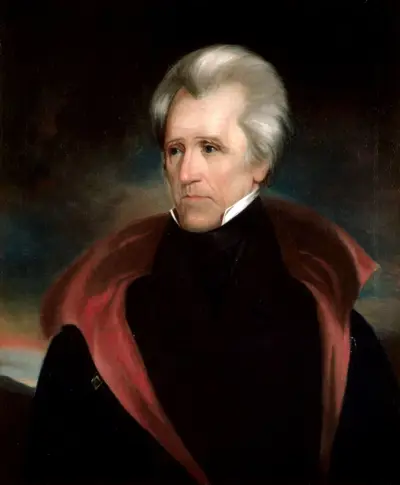
Andrew Jackson was an American lawyer, soldier, and statesman who served as the seventh president of the United States from 1829 to 1837. Before being elected to the presidency, Jackson gained fame as a general in the United States Army and served in both houses of the U.S. Congress. An expansionist president, Jackson sought to advance the rights of the "common man" against a "corrupt aristocracy" and to preserve the Union.
