Vladimir Lenin Quotes
We can't expect to get anywhere unless we resort to terrorism: speculators must be shot on the spot. Moreover, bandits must be dealt with just as resolutely: they must be shot on the spot.
Vladimir Lenin. At the time of the Russian Revolution, the country was a mess for all except the very rich and the nobles. Food was very scarce and speculators would buy up food and hoard it driving the price way up while some people starved. Bandits were active throughout the country stealing anything at gunpoint so that they could buy food. Meanwhile the country had been at war with Germany and the previous law enforcement was the Czar’s’ police who were now overthrown and there were no law enforcement officers in most places. Much of the nation was in chaos. Lenin and others urged extreme measures which were used to stabilize things at a horrendous cost in human rights and human life. Many Russians were shot, having been unjustly accused by people settling scores. Terror meant the act of terrorizing people in order to get them to behave in a certain way—not unlike the purpose of modern terrorists.
Nikolai Lenin, 1870-1924, Russian Communist Premier Meeting of the Presidium of the Petrograd Soviet With Delegates From the Food Supply Organizations, January 27, 1918
Sourced by: Eigen's Political and Historical Quotations

Lev Davidovich Bronstein. Lenin Did not agree and thought things were so desperate after the 1917 Revolution so that he advocated terrorism {636607} to stabilize the society. Stalin in contrast thought that terror was indispensable and this was one of the major reasons Stalin and Trotsky fell out and by this means, Stalin had Trotsky murdered when he was in exile in Mexico.

Dagestan was the poorest of the Soviet States, It was then mainly populated by feuding Muslim sects who were in constant conflict with each other and an Islamic nationalist group that wanted independence from Russia. There were also a large number of bandits in what was a frontier culture of banditry and lawlessness.


Islamic extremists had killed thousands on Russian citizens and military men in Chechen, one of the states in Russia. At the time--before 9-11--Americans in the homeland had never been attacked by Islamic religious extremists as the Russians had. Some Americans were very critical of the Russians for using force and troops to deal with the terrorists and urged Putin to negotiate. This was Putin's reply. It was taken by many Americans as an unnecessarily hard line then. After 9-11, however, American views towards negotiations with terrorists generally resembled Putin in this quotation. Many Americans then developed much more sympathy with the Russian position on terrorism inside Russia.


He had a lifelong hatred toward the Internal Revenue Service. Finally he crashed his single engine airplane into the IRS offices, killing an IRS agent and committing suicide in a different version of suicide bombing.


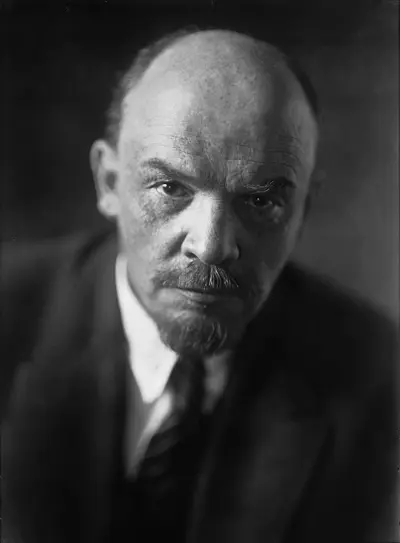
- Born: April 22, 1870
- Died: January 21, 1924
- Nationality: Russian
- Profession: Revolutionary, Politician
Vladimir Ilyich Ulyanov, better known by his alias Lenin, was a Russian revolutionary, politician, and political theorist. He served as the first and founding head of government of Soviet Russia from 1917 to 1924 and of the Soviet Union from 1922 to 1924. Under his administration, Russia, and later the Soviet Union, became a one-party socialist state governed by the Soviet Communist Party. A Marxist, he developed a variant of this communist ideology known as Leninism.
