Leon Trotsky Quotes
In our eyes, individual terror is inadmissible precisely because it belittles the role of the masses in their own consciousness, reconciles them to their own powerlessness, and turns their eyes and hopes toward a great avenger and liberator who someday will come and accomplish his mission.
Lev Davidovich Bronstein. Lenin Did not agree and thought things were so desperate after the 1917 Revolution so that he advocated terrorism {636607} to stabilize the society. Stalin in contrast thought that terror was indispensable and this was one of the major reasons Stalin and Trotsky fell out and by this means, Stalin had Trotsky murdered when he was in exile in Mexico.
Leon Trotsky, 1879-1940, Russian Revolutionist, “Why Marxists oppose Individual Terrorism”, Austrian Social Democratic paper Der Kampf, 1909
Sourced by: Eigen's Political and Historical Quotations

Vladimir Lenin. At the time of the Russian Revolution, the country was a mess for all except the very rich and the nobles. Food was very scarce and speculators would buy up food and hoard it driving the price way up while some people starved. Bandits were active throughout the country stealing anything at gunpoint so that they could buy food. Meanwhile the country had been at war with Germany and the previous law enforcement was the Czar’s’ police who were now overthrown and there were no law enforcement officers in most places. Much of the nation was in chaos. Lenin and others urged extreme measures which were used to stabilize things at a horrendous cost in human rights and human life. Many Russians were shot, having been unjustly accused by people settling scores. Terror meant the act of terrorizing people in order to get them to behave in a certain way—not unlike the purpose of modern terrorists.

The “area” was Chechnya, a province of Russia with a substantial Muslim population. Islamic forces were not as unhappy in the Russian Communist days in the Christian Orthodox church was subdued, but after the fall of Communism, the Russian Orthodox church had a revival, and that exacerbated all the independence aspirations that existed for years in Chechnya.


Vladimir Lenin


Vladimir Lenin. Some anti-democratic, rabid opponents of communism used this quotation to argue that democracy was just a step on the way to Communism and thus democracy was a part of the communist conspiracy—an extreme form of Red Scare.

This is a very important historical, political quotation. The conservatives have since the Russian Revolution conflated socialism and communism. However, here in 1932 the leader of the American Socialist Party had already described the Communist Revolution in Russia as a failure of founding an acceptable modern state. Nonetheless, even into the 21st century many conservatives describe Thomas as a Communist. See {626692} for his distinction between Communism and Socialism. The difficulty of modern nation building was explained by Thomas and others but was really not accepted until the many attempts of the early 21st century, some supported by America like Iraq and Afghanistan and the Balkans and others like the “Arab Spring.” Then his early wisdom on this point became more appreciated.

Despite his speeches like this one, he was a ruthless dictator who then before his death in 2000 handed power to his son.

This quotation was documented by an FBI illegal wiretap of King and his associates. The illegal wiretap had been insisted upon by FBI Director J. Edgar Hoover who was a racist and somewhat of a paranoid about communists. However, Attorney General, Robert F. Kennedy personally approved the illegal wiretap.

He was elected to Parliament while in jail and never took his seat as he died of a hunger strike in jail.

Vladimir Lenin
He was a major critic of Socialism but he did acknowledge that the Socialist Movement had made major contributions.


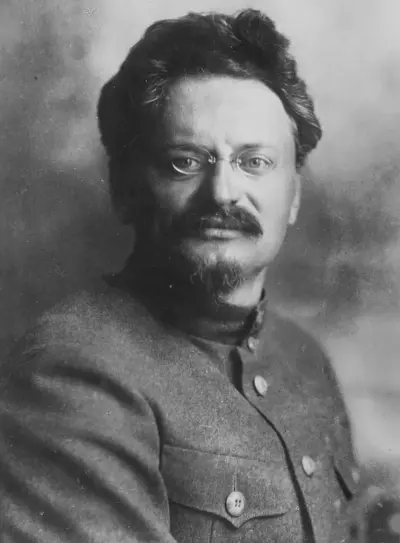
- Born: November 7, 1879
- Died: August 21, 1940
- Nationality: Russian
- Profession: Revolutionary; Political Pholosopher & Revolutionist
Lev Davidovich Bronstein, better known as Leon Trotsky (/ˈtrɒtski/), was a Russian Marxist revolutionary, political theorist and politician. Ideologically a communist, he developed a variant of Marxism which has become known as Trotskyism.
