Tom Denning Quotes
Is it right for us, as a society, to do a thing – hang a man – which none of us individually would be prepared to do or even witness? The answer is 'no, not in a civilized society
In his early career, her supported capital punishment, but changed his mind as can be seen in this quotation.
Alfred Denning, 1899–1999, Baron Denning, English Judge & Mathematician, Member of the House of Lords, 1984
Sourced by: Eigen's Political and Historical Quotations

Although this is generally followed as a legal principle in America, states like Texas have executed felons who most other jurisdictions would see as Coke’s “mad man.”


Einstein had changed his mind. He like almost everyone else at the time favored the death penalty, but in 1927 came to the new conclusion for the same reasons that many American politicians stated 70 years later. He had no compunctions against capital punishment for murderers who were dangers to society, but the potential error of the justice system led him to oppose state sanctioned execution. At the time the number of errors in capital cases that had been demonstrated were few. But as a scientist, Einstein knew that all human endeavors were prone to error. He was a strong law and order supporter however—see {588606}.


Elliott had electrocuted over 400 condemned criminals including Sacco and Vanzetti and the first woman who was electrocuted.


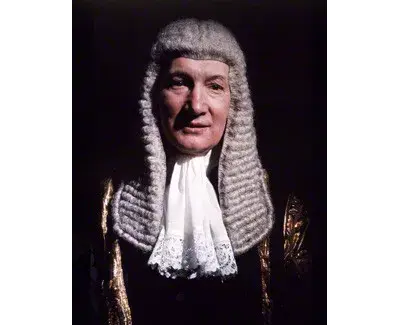
Alfred Thompson "Tom" Denning, Baron Denning, OM, PC, DL was an English lawyer and judge. He was called to the bar of England and Wales in 1923 and became a King's Counsel in 1938. Denning became a judge in 1944 when he was appointed to the Probate, Divorce and Admiralty Division of the High Court of Justice, and transferred to the King's Bench Division in 1945. He was made a Lord Justice of Appeal in 1948 after less than five years in the High Court. He became a Lord of Appeal in Ordinary in 1957 and after five years in the House of Lords returned to the Court of Appeal as Master of the Rolls in 1962, a position he held for twenty years. In retirement he wrote several books and continued to offer opinions on the state of the common law through his writing and his position in the House of Lords.
