Albert Einstein Quotes
I have reached the conviction that the abolition of the death penalty is desirable. Reasons: (1) Irreversibility in the event of an error in justice; (2) detrimental moral influence on those who have to carry out the procedure.
Einstein had changed his mind. He like almost everyone else at the time favored the death penalty, but in 1927 came to the new conclusion for the same reasons that many American politicians stated 70 years later. He had no compunctions against capital punishment for murderers who were dangers to society, but the potential error of the justice system led him to oppose state sanctioned execution. At the time the number of errors in capital cases that had been demonstrated were few. But as a scientist, Einstein knew that all human endeavors were prone to error. He was a strong law and order supporter however—see {588606}.
Albert Einstein, 1879-1955, Nobel laureate in Physics, Letter to a Berlin Publisher, November 2, 1927
Sourced by: Eigen's Political and Historical Quotations

Einstein was a very independent thinker. At the time many intellectuals were thinking that with modern psychology and sociology man could determine why criminals behaved in anti-social manners. However, Einstein was more concerned with the practical problems of protecting society. He was an opponent of the death penalty however. See {588604}.


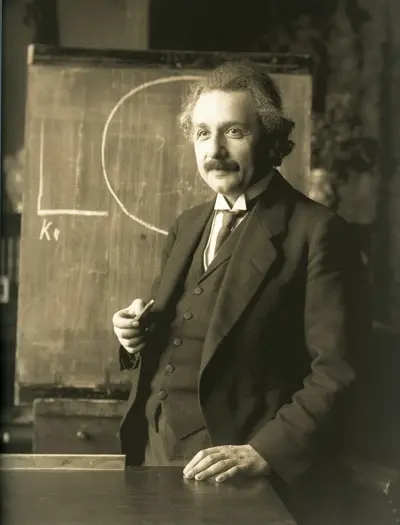
- Born: March 14, 1879
- Died: April 18, 1955
- Nationality: German, Swiss, American
- Profession: Physicist
Albert Einstein was a German-born theoretical physicist, widely acknowledged to be one of the greatest physicists of all time. Einstein is known for developing the theory of relativity, but he also made important contributions to the development of the theory of quantum mechanics. Relativity and quantum mechanics are together the two pillars of modern physics. His mass–energy equivalence formula E = mc2, which arises from relativity theory, has been dubbed "the world's most famous equation". His work is also known for its influence on the philosophy of science. He received the 1921 Nobel Prize in Physics "for his services to theoretical physics, and especially for his discovery of the law of the photoelectric effect", a pivotal step in the development of quantum theory. His intellectual achievements and originality resulted in "Einstein" becoming synonymous with "genius".
