Jefferson Davis Quotes
What security have you for your own safety if every man of vile temper, of low instincts, of base purpose, can find in his own heart a higher law than that which is the rule of society, the Constitution, and the Bible? These higher-law preachers should be tarred and feathered, and whipped by those they have thus instigated. This, my friends, is what was called in good old revolutionary times, Lynch Law. It is sometimes the very best law, because it deals summary justice upon those who would otherwise escape from all other kinds of punishment.
The South had a tradition of lynching even before Reconstructon. Southern Leaders like Jefferson encouraged and justified the heinous practice. In the West there was a good bit of vigilantism justified by the fact that there was no functioning legal system and few law enforcement officers. But Jefferson and many other Southerners, although there was a law enforcement system except in the most rural areas, advocated lynching as a combination of vengeance and other emotions that are hard to identify.
Jefferson Davis, 1808-1889, U. S. Congressman & U. S. Senator (Democrat, MS), U. S. Secretary of War, President, Confederate States of America, Speech in New York, 1858
Sourced by: Eigen's Political and Historical Quotations


South Carolina passed a state law which overrode and nullified Federal Laws that they did not like. It was a type of secession. President Jackson, in his own blunt style, let them know that they had better not try to implement their nullification law. Of all the Presidents in American History, Jackson had the least respect for Constitutionality and due process. He had a history of summary execution where he was the judge, jury and almost the personal executioner. He is the only president in American history who refused to obey and order of the Supreme Court. There were few who doubted that he would make good on his threat. The South Carolina convention reconvened and repealed its Nullification Ordinance on March 11, 1833.

For years through the Jim Crow years, Whites murdered many Blacks with impunity if they were perceived to be uppity or to try and obtain their Constitutionally Protected rights. Most took place in the South. The Negroes were typically tortured, mutilated, burned and hung from trees where they would be left for days as the major purpose was to strike terror in the Southern Black population. The Southern State and local governments never opposed the policy via oratory, legislation of law enforcement. The Federal Government did not interfere either. And much of the FBI under J. Edgar Hoover actually enabled the White Citizen’s Councils and the Klu Klux Klan. The NAACP began an anti-lynching campaign and Ms. Holiday was a one-woman public exposure campaign centered around this song. The anthem itself was written by a New York City schoolteacher named Abel Meeropol, using the pen name, Lewis Allan. It reached millions of Americans and Holiday fans the world over. To view some of the historical scenes described in the song, see http://withoutsanctuary.org/main.html

What makes this quotation so historically interesting is that the abiding by the Supreme Court’s decisions on constitutionality was even an issue. It was because of the terrible Dred Scott decision which required Northern States to return fugitive slaves to their owners despite the constitutions of those states which stated that all men were free. A substantial part of the Democratic Party was the “solid South” and the return of fugitive slaves was one of the major issues of the 1860 Presidential Election. Ironically, the Southern States were arguing AGAINST states’ rights when the Northern States’ laws and Constitutions made fugitive slaves free the minute they set foot in the state.

Several years before the Battle of Bunker Hill, revolutionary activity had already broken out in the American colonies—See {634132} for an example. This law gave the British authorities much more “clout” in dealing with the “seditious” American activities. It protected English law enforcement officials from being tried in local Colonial courts for murder or assault in putting down insurrections. George Washington and other Patriots were outraged over this law. See {634131}.
This statement was published in a major magazine of the time. It referred to a notorious lynching in the South where the victim had been brutally tortured and burned to death. In this case the victim had apparently committed a horrible crime. The Bishop condemned the horrific nature or the lynching but took the view that it was an act of insanity and that the relatives of the child killed by the lynching victim may well have been driven to insanity by the act However, this lynching, like most all in the South was not just an act of vengeance—insane or not—by relatives of a victim, it was participated on by a large mob, many of whom had no relationship to any of the parties. Whites who committed horrible crimes were rarely lynched, but many accused Blacks were lynched even though they turned out to have been innocent.
In the wake of the Dred Scott Supreme Court decision, most Northern newspapers and leaders opposed the decision and argued against compliance—especially the Republican newspapers. However, some Northern newspapers were Democratic supporters and argued that the Supreme Court must be obeyed and to oppose the court is to oppose the Constitution itself.


Mashall was then Solicitor General of the United States.

The speech was in the midst of a very bitter strike where goons and strikebreakers assaulted miners and a few miners resorted to violence.

Mormons were not only discriminated against but frequently robbed, murdered and ethnically cleansed from different parts of the country. In general the Federal Government did little or nothing regarding the plight of the Mormons.

Powell was the Secretary of State and Addington kept advising the administration that as long as the President was acting in defense of the country in his capacity as Commander in Chief, he did not have to obey any existing laws that had been Constitutionally passed which in the opinion of the President restricted or limited the President or the executive branch. Addington was an attorney and Assistant to the Vice President, but he was given much responsibility for administration policy. Powell the Secretary of State of the Administration could not have disagreed more and although most politicians including Republicans disagreed with the Addington thesis, Powell was one of the few Republicans to criticize the Addington position.


It is a common misconception that anarchists would not have any societal mechanism for preventing and combatting crime. Anarchists believe in the long run that with anarchism the reasons and motivations for crime will disappear, but until then they generally have been willing to use force to protect against force being used against the citizens. To critics, this seems to be government, and a government which uses force. Anarchists have never well detailed how they would manage such a seemingly conflicting situation.


In 1786, many veterans of the American Revolution had still not yet been paid the promised wages for their military service by the new national government. The States however had imposed taxes on farms to fund the new state governments and pay the state’s war debts mostly to rich merchants. Many veterans could not pay the taxes and some were thrown into debtors’ prison, and others had their farms foreclosed. Led by Daniel Shays, a small group of Massachusetts men conducted a mini rebellion by closing local court houses and tried to take over the local state armory. The Governor put down the rebellion by force and the rebels were jailed. Adams, the the former governor, recommended the death penalty and several of the rebels were executed. Thomas Jefferson disagreed. See {604839} for his famous quotation on the subject. This was one of the early crises of the new country and it was handled very poorly and unfairly.

This is one of the major reasons that the relations between police and the communities they are policing is so important. Also, the style and courtesy that the IRS tax collectors exhibit is very important.

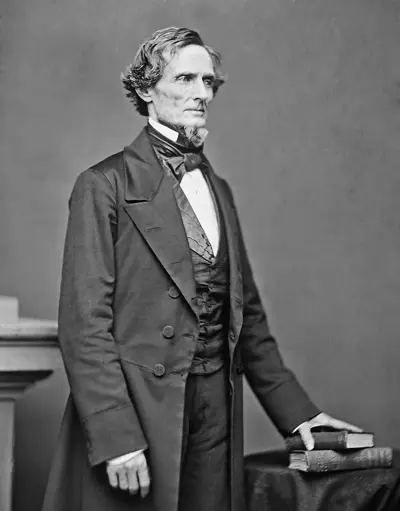
Jefferson Finis Davis was an American politician who served as the president of the Confederate States from 1861 to 1865. As a member of the Democratic Party, he represented Mississippi in the United States Senate and the House of Representatives before the American Civil War. He previously served as the United States Secretary of War from 1853 to 1857 under President Franklin Pierce.
