Peter Balakian Quotes
History has shown that when justice is not served in a legal capacity, some people will take matters into their own hands.
Peter Balakian, Historian, The Burning Tigris, 2003
Sourced by: Eigen's Political and Historical Quotations


This statement was published in a major magazine of the time. It referred to a notorious lynching in the South where the victim had been brutally tortured and burned to death. In this case the victim had apparently committed a horrible crime. The Bishop condemned the horrific nature or the lynching but took the view that it was an act of insanity and that the relatives of the child killed by the lynching victim may well have been driven to insanity by the act However, this lynching, like most all in the South was not just an act of vengeance—insane or not—by relatives of a victim, it was participated on by a large mob, many of whom had no relationship to any of the parties. Whites who committed horrible crimes were rarely lynched, but many accused Blacks were lynched even though they turned out to have been innocent.


There violence was extreme on both sides. However, the Fascist / Nationalists had a firm policy of violence and terrorism. The institutions of society had so broken down that vigilantism and revenge drove the Republicans to almost the level of atrocities as the Nationalists.

The revolution turned on many of its initiators including Vergniaud. He was guillotined along with other Girondists.
This proverb only makes sense in the light of understanding the Arab concept of revenge—“blood.” In a rural desert environment where little can be expected of government, the Arabs have developed a law enforcement and peace keeping mechanism which while primitive from modern standards, nevertheless worked to some degree. It is that revenge—“blood” is a moral necessity and obligation of all people, and revenge is not limited by time or to the individuals involved in the first incidence. The immediate family are the first to exact revenge, but the extended family follows and often the entire clan. Sometimes revenge is tribal or even national. Anyone who fails to revenge a member in his group is not only a disgrace, but is a clear and present danger to the group because then they can be attacked with impunity. So revenge is a strong obligation of the group members and blood must be paid with blood no matter how many generations it may take. The only thing that keeps me and my family safe, is the surety what whosoever kills one of us will themselves be killed or if they die a natural death we will take revenge on one of the evildoers relatives and no one is exempt. Crime must never pay!


The right of vengeance was written into the first book of law for the Muslims. It was a very strong part of the culture long before Muhammad, amongst all the tribes. Before there were organized law enforcement agencies, family and tribal vengeance was the basic mechanism of law enforcement. Unfortunately for many cultures and people, it still is a legitimate method of law enforcement—even in many of the modern industrial democracies.

Actually under Islamic law teh relatives of the victems can grant mercy, and they are frequently paid money by the family and friends of the accused murderer to do so. in many cases, the wealthy offender can avoid even long jail terms. However, if the victim's family is also very wealthy, they would often exact vengeance and have the killer executed. This is one major difference between must Western law and Islamic law. In the West we do not giver the relatives of the victim any significant role in the process. Vengeance is not recogniszed and it is society that acts. Recently some states have allowed victim families to man imact statment s to the jury or judge. There had been an aborted revolution and several hundred Turks were killed in the battles betwen the revolutionists and the police and non-revolutionary soldiers.


Simon Bolivar and other freedom fighters in South America used this quotation to justify numerous acts of retaliation against the Spanish troops controlling their countries.


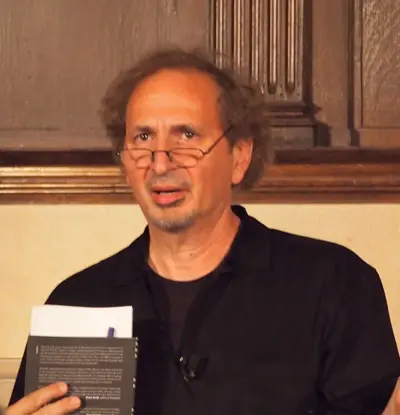
Peter Balakian is an Armenian American poet, writer and academic, the Donald M. and Constance H. Rebar Professor of Humanities at Colgate University. He was awarded the Pulitzer Prize for Poetry in 2016.
