Horace Greeley Quotes
I do not intrude to tell you - for you must know already - that a great proportion of those who triumphed in your election, and of all who desire the unqualified suppression of the rebellion now desolating our country, are solely disappointed and deeply pained by the policy you seem to be pursuing with regard to the slaves of the Rebels. We think you are strangely and disastrously remiss in the discharge of your official and imperative duty with regard to the emancipating provisions of the new Confiscation Act. Those provisions were designed to fight slavery with liberty
This was the letter which triggered Lincoln’s famous reply. See {609337}.
Horace Greeley, 1811-1872, Newspaper Editor & Candidate for the Liberal Republican Presidential nomination (Defeated by Ulysses S. Grant), Letter to President Abraham Lincoln, August 19, 1862
Sourced by: Eigen's Political and Historical Quotations


This was one of the several early unofficial Emancipations that was issued in the Civil War.

There indeed were although the Southerners tended to exaggerate the numbers. However, the more slavery was debated, the more many of the abolitionists came to believe that insurrection and slave rebellion was not only morally justified but was the only recourse that was left by the racist intransigence of the Southern slave holders and politicians.


One of the interesting arguments made against slavery prior to the Civil War was that as the proportion of slaves increased in America in general and the South in particular, the security risk from a slave rebellion increases markedly to the point that it was just too risky. John Brown’s small attempted slave revolt at Harpers Ferry put the entire state of Virginia in a panic and Virginia had relatively few slaves compared with deep South states.

For the required Oath, see {623308} . There were several to the amnesty. These included graduates of West Point and the Naval Academy who had joined the rebellion, senior officers and officials of the Confederacy, those who were accused of war crimes and abusing Union prisoners of war, persons who went abroad to help the Confederacy, and Northerners who had gone South to aid the rebellion. Many scholars think that although Lincoln had expressed his desire to provide an amnesty after the war was over, he probably would have been more lenient than Johnson who exempted many on the Southern side—especially the leaders. Ironically, Johnson was a Southerner but was personally, morally outraged at taking up arms against the United States and in that sense was much more of a hawk than Lincoln and many of the radical Republicans even. However, he was an inveterate racist and resisted most of the attempts to implement equality during the Reconstruction. Many argue that but for Johnson, Reconstruction might have been much more successful. It was easy for Southerners to resist equal rights for Blacks when they knew that the President was also opposed to measures to produce equality.


Much of the South was so insular that people knew nothing about the notion of abolition and just assumed that no one would ever consider freeing the slaves. Many never knew that it was the South that first fired on the Union troops and flag. If the North won the war, the assumption was that Northerners would then own the plantations and the valuable slaves. In reality, while all slaves were emancipated in the South, very few plantations and farms were confiscated from their Southern owners by Northerners despite the fact that there was political pressure in the North to confiscate the land of all rebels who had committed treason and use the value to repay the Union bonds and care for the wounded Union veterans and the widows of dead Union Soldiers. Eggleston was an accomplished writer who had served in the Confederate army of the Civil War. 20 year after the war he wrote a series of articles for the prestigious Northern Atlantic Monthly trying to convey the war from the Southerner’s point of view.

This prophecy written in the later years of Jefferson’s life turned out to be all too true. St. Domingo was an Island in the Caribbean where slavery produced a bloody war. The American Civil War would be far worse.

Marx followed the American Civil War very closely. The freeing of the slaves caused an immediate social, moral and economic revolution, the results of which we live with today.

Butler was at the time the Union general in charge of Louisiana. He had on his hand a large group of slaves whose owners had abandoned the area. There was no emancipation yet. He wrote for instructions. The result was the first actual emancipation of slaves.
Note that Lincoln did not justify the emancipation proclamation on moral or humanitarian grounds, but on the grounds of military necessity.


His prediction would come true 72 years later. He was a slave trader and a strong supporter of the institution. See {624060}. However unlike most slave supporting Southerners, he came from one of the richest families of New England. His own brother Moses Brown was an ardent abolitionist and John was able to see the arguments and forces lined up against slavery. He saw that abolitionists as the trouble makers because they were trying to change the status quo. Having much experience with Southerners and selling them many slaves, he realized early how the South was totally dependent on slavery for its economic and social way of life. Few Americans had that broad a perspective.
In the Civil War a drafted conscript could pay money instead of serving in the army. Many rich and middle class men did so leaving a higher proportion of the poor to be drafted. The song is sometimes misattributed to William Cullen Bryant.

This was one of the first calls for a slave strike in America.

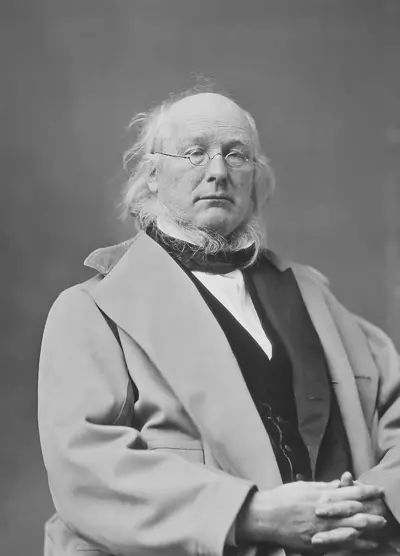
- Born: February 3, 1811
- Died: November 29, 1872
- Nationality: American
- Profession: Editor
Horace Greeley was an American newspaper editor and publisher who was the founder and editor of the New-York Tribune. Long active in politics, he served briefly as a congressman from New York, and was the unsuccessful candidate of the new Liberal Republican Party in the 1872 presidential election against incumbent President Ulysses S. Grant, who won by a landslide.
