Chicago Tribune Quotes
If a supposed insurrection in the sparse slave population of Northern Virginia throws the whole South into consternation, what kind of security will that section enjoy when thousands of ship loads of the same incendiary material have been brought from Africa, filling up the southern States? We appeal to the conservative men of the country to say which is the safest and best policy: the Democratic, which is striving to multiply and expand this volcanic element, or the Republican which seeks to limit and circumscribe it, and place it on the way of ultimate extinction.
One of the interesting arguments made against slavery prior to the Civil War was that as the proportion of slaves increased in America in general and the South in particular, the security risk from a slave rebellion increases markedly to the point that it was just too risky. John Brown’s small attempted slave revolt at Harpers Ferry put the entire state of Virginia in a panic and Virginia had relatively few slaves compared with deep South states.
Chicago Tribune, Editorial on the John Brown Rebellion at Harpers Ferry, October 26, 1859
Sourced by: Eigen's Political and Historical Quotations

There indeed were although the Southerners tended to exaggerate the numbers. However, the more slavery was debated, the more many of the abolitionists came to believe that insurrection and slave rebellion was not only morally justified but was the only recourse that was left by the racist intransigence of the Southern slave holders and politicians.
The last lines of the editorial were tragically accurate in predicting the Civil War. The more the slavery question was debated in the nation, the more polarized the country became. If the South would persist in trying to curtail men’s freedom and maintain slavery, the slaves had the same right of revolution and insurrection as was established in the American Revolution. That was the view of most abolitionists. Southern slave holders, feared an armed slave rebellion more than anything else, and observed that debating the issue of slavery was just riling up Blacks and whites and would instigate such armed revolutions. The Southern solution was to cease debating the slavery question. The Northern solution was to end slavery. Neither side would accept the solution of the other and the Civil War ensued.


It was not successful militarily and Brown and his followers were hanged, but they rapidly became martyrs to the cause of freedom and abolition. As such they inspired not only abolitionists but many of the Northern soldiers in the Civil War. There were verses to the Battle Hymn of the Republic which were often sung by the Union Troops.”


Brown wanted Douglass to join his band of 22 men for the raid on Harper's Ferry. Douglass not only refused to join but tried to dissuade Brown from carrying out the raid.

This was the letter which triggered Lincoln’s famous reply. See {609337}.

The amendments failed as did the compromise.


In many respects, it is amazing that secession did not take place earlier.


Much of the South was so insular that people knew nothing about the notion of abolition and just assumed that no one would ever consider freeing the slaves. Many never knew that it was the South that first fired on the Union troops and flag. If the North won the war, the assumption was that Northerners would then own the plantations and the valuable slaves. In reality, while all slaves were emancipated in the South, very few plantations and farms were confiscated from their Southern owners by Northerners despite the fact that there was political pressure in the North to confiscate the land of all rebels who had committed treason and use the value to repay the Union bonds and care for the wounded Union veterans and the widows of dead Union Soldiers. Eggleston was an accomplished writer who had served in the Confederate army of the Civil War. 20 year after the war he wrote a series of articles for the prestigious Northern Atlantic Monthly trying to convey the war from the Southerner’s point of view.

Darwin was then a very young man, who had personal witnessed the slavery in South America and the Caribbean when he was on his famous expedition on HMS Beagle. See {630961} & {630962}. He was so disgusted with slavery that he hoped there would be armed slave revolutions and takeovers as had occurred in Haiti. Many of the English upper classes were radical when it came to slavery.

This prophecy written in the later years of Jefferson’s life turned out to be all too true. St. Domingo was an Island in the Caribbean where slavery produced a bloody war. The American Civil War would be far worse.

This fear was great among many who were abolitionists as potentially there might be mass slaughter of all Southern whites.
In 1856 Kansas was at war over slavery. Kansas was to enter the Union with the resident men voting to determine whether it would be a slavery state or a free state. At first pro-slavery forces sent men into Kansas to increase the pre-slavery vote. The abolitionist anti-slavery forces outside of Kansas did the same, and had more money to finance anti-slavery settlers. Soon the pro-slavery forces, realizing that they would be outnumbered turned to violence and began to intimidate abolitionist settlers to return from whence they came. Soon abolitionists were killed and the anti-slavery men retaliated. Soon real war broke out but terrorism was the modality on most attacks as the purpose of the pro-slavery men was to frighten the abolitionists—many of whom were religious pacifists—into leaving the state. Brown and some other abolitionists retaliated with terror of their own, but Brown was rabid. He and his sons, attacked 5 pro-slavery fighters at Pottawatomie Creek, but Brown personally hacked off their limbs with a broadsword and left the bodies to intimidate and terrorize many of the pro slavery people. Brown was such a fanatic that he, in this infamous quote, claimed that his killing and butchery was “justified under the circumstances.” The phrase “Bleeding Kansas” came from the violence and terrorism in this period.

The Governor was a staunch Confederate supporter but his state legislature majority favored the Union. He was forced out of the governorship when the 1861 election gave the legislature a veto-proof pro Union majority.


This was one of the several early unofficial Emancipations that was issued in the Civil War.
The Southern states were illegal rebels. A confederacy had always meant a voluntary association of otherwise independent entities. However technically the Southern states were not independent but in a state of illegal rebellion against the United States. Lincoln, a lawyer, could not being himself to refer to the South by their preferred name—the Confederacy. So this was how he and many in his administration referred to the South.
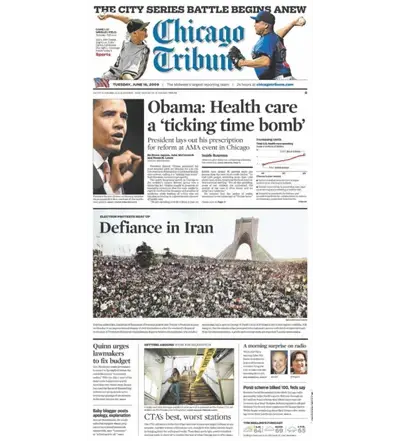
The Chicago Tribune is a daily newspaper based in Chicago, Illinois, United States, owned by Tribune Publishing. Founded in 1847, and formerly self-styled as the "World's Greatest Newspaper" (a slogan for which WGN radio and television are named), it remains the most-read daily newspaper of the Chicago metropolitan area and the Great Lakes region. It had the sixth highest circulation for American newspapers in 2017.
