William Lloyd Garrison Quotes
… a misguided, wild and apparently insane act
It was not successful militarily and Brown and his followers were hanged, but they rapidly became martyrs to the cause of freedom and abolition. As such they inspired not only abolitionists but many of the Northern soldiers in the Civil War. There were verses to the Battle Hymn of the Republic which were often sung by the Union Troops.”
William Lloyd Garrison, 1805-1879, Editor & Abolitionist Description of John Brown’s Raid and Attempted Slave Revolt at Harper’s Ferry, 1859
Sourced by: Eigen's Political and Historical Quotations

In 1856 Kansas was at war over slavery. Kansas was to enter the Union with the resident men voting to determine whether it would be a slavery state or a free state. At first pro-slavery forces sent men into Kansas to increase the pre-slavery vote. The abolitionist anti-slavery forces outside of Kansas did the same, and had more money to finance anti-slavery settlers. Soon the pro-slavery forces, realizing that they would be outnumbered turned to violence and began to intimidate abolitionist settlers to return from whence they came. Soon abolitionists were killed and the anti-slavery men retaliated. Soon real war broke out but terrorism was the modality on most attacks as the purpose of the pro-slavery men was to frighten the abolitionists—many of whom were religious pacifists—into leaving the state. Brown and some other abolitionists retaliated with terror of their own, but Brown was rabid. He and his sons, attacked 5 pro-slavery fighters at Pottawatomie Creek, but Brown personally hacked off their limbs with a broadsword and left the bodies to intimidate and terrorize many of the pro slavery people. Brown was such a fanatic that he, in this infamous quote, claimed that his killing and butchery was “justified under the circumstances.” The phrase “Bleeding Kansas” came from the violence and terrorism in this period.

One of the interesting arguments made against slavery prior to the Civil War was that as the proportion of slaves increased in America in general and the South in particular, the security risk from a slave rebellion increases markedly to the point that it was just too risky. John Brown’s small attempted slave revolt at Harpers Ferry put the entire state of Virginia in a panic and Virginia had relatively few slaves compared with deep South states.

The last lines of the editorial were tragically accurate in predicting the Civil War. The more the slavery question was debated in the nation, the more polarized the country became. If the South would persist in trying to curtail men’s freedom and maintain slavery, the slaves had the same right of revolution and insurrection as was established in the American Revolution. That was the view of most abolitionists. Southern slave holders, feared an armed slave rebellion more than anything else, and observed that debating the issue of slavery was just riling up Blacks and whites and would instigate such armed revolutions. The Southern solution was to cease debating the slavery question. The Northern solution was to end slavery. Neither side would accept the solution of the other and the Civil War ensued.

Brown wanted Douglass to join his band of 22 men for the raid on Harper's Ferry. Douglass not only refused to join but tried to dissuade Brown from carrying out the raid.


This fear was great among many who were abolitionists as potentially there might be mass slaughter of all Southern whites.
Brown was executed for trying to steal federal arms and start a slave rebellion. However, to many Americans, his moral judgment was correct. He became a martyr for many abolitionists, and some Northern Civil War songs extolled him and saw his as an early forerunner of a great moral struggle. See Thoreau {633849} as an example. There were many other Americans who were abolitionists and did not approve of either of the method his violent raid or its purpose of arming the slaves as they feared a bloodbath of vengeance.
1st Marquis of Peña Plata
There indeed were although the Southerners tended to exaggerate the numbers. However, the more slavery was debated, the more many of the abolitionists came to believe that insurrection and slave rebellion was not only morally justified but was the only recourse that was left by the racist intransigence of the Southern slave holders and politicians.

John Brown, in a futile effort to start a slave insurrection, raided the arsenal at Harper’s Ferry. His raid failed and he was captured and hanged. However, he became a martyr to the abolitionist movement, and his death is still sung of gloriously to this day. See {584889} and {604003}.

Referring to fellow Republican, Senator Jesse Helms:
During the 1830’s the debate over whether the British Empire should abolish slavery was revived and caused much unrest, It illustrates the total incompatibility between slavery and literacy & education.
Douglass tried to talk Brown out of what Douglass thought would be a suicide raid. Douglass was right.
The Reference to St. Domingo refers to the slave rebellion in Haiti, the first major, and successful slave revolt in the Western Hemisphere. The revolution was characterized by the revenge taken against the former slave masters. Thomas Jefferson, then the President, refused to recognize the new government and actually boycotted it. He and most Americans at the time were fearful that a slave revolt in the U. S. would produce revenge attacks against former masters, and indeed the national government supported the slave owners in subjugating all attempted armed rebellion. This reached its zenith in the Federal troops putting down the John Brown attempted revolt at Harpers Ferry. Instead of the bloodshed of a slave revolt, America experienced the bloodshed of a Civil War.

This may be the first formal resolution against slavery in the Americas. This quotation shows the fact that not only did these Mennonites oppose slavery, and chastise those who bought slaves as much as the slave capturers, but they argued that the slaves had a perfect right to armed struggle to free themselves—the greatest fear of slaveholders in America. The term “negers” was not a word of disrespect but was derived from the low German spoken by the Mennonites.

The Japanese Government was in the control of ardent militarists intent on expanding the Japanese empire. They invaded Manchuria and had designs on China. The League of Nations was very weak, in large part because the United States had not joined when the Senate refused to ratify the treaty. So peace or war In Asia depended on the fascist, military clique that ruled Japan.

Darwin was then a very young man, who had personal witnessed the slavery in South America and the Caribbean when he was on his famous expedition on HMS Beagle. See {630961} & {630962}. He was so disgusted with slavery that he hoped there would be armed slave revolutions and takeovers as had occurred in Haiti. Many of the English upper classes were radical when it came to slavery.

In 1831 a slave preacher, Nat Turner, led a rebellion in North Carolina killing over 50 white men, women and children. Even though Turner and the rebels were captured and executed, whites throughout the South, took vengeance on any slaves they could find.
The reason for the initial total killing policy was that the slaves had no arms. Their plan was for a small band to attack a plantation, seize the owner’s arms, free his slaves enlarging the “army”, and going on to the next plantation. The reason for the total killing of the whites was to prevent a survivor running to the authorities and mounting a counter attack on the slaves while they still had few guns. The plan was to form an armed slave army and then fight a conventional battle. Ironically, one white who was wounded and spared actually did reach the authorities and Turner’s band was attacked before they had sufficient weapons to put up a serious fight.

This prophecy written in the later years of Jefferson’s life turned out to be all too true. St. Domingo was an Island in the Caribbean where slavery produced a bloody war. The American Civil War would be far worse.


Louis Napoleon Bonaparte. The “colonies” to which we was referring were the French Colonies in the Caribbean—particularly Haiti. The Black slaves had revolted against the slave-owners and had taken over all positions of authority and wore the uniforms and symbols of power including the epaulettes—the gold braid shoulder pieces that were symbols of high rank in military and diplomatic uniforms which were worn on all official occasions. Napoleon never did make good on his vow. He had many more problems with his own wars and governance in Europe. This quote does demonstrate the racism that existed in supposedly tolerant France.
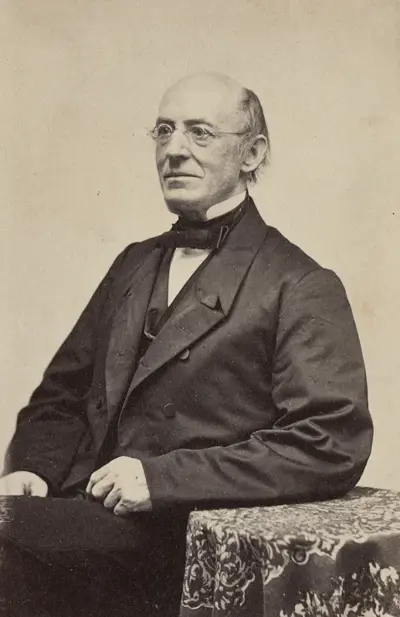
William Lloyd Garrison, who signed and printed his name Wm. Lloyd Garrison, was a prominent American abolitionist, journalist, suffragist, and social reformer. He is best known for his widely-read anti-slavery newspaper The Liberator, which he founded in 1831 and published in Boston until slavery in the United States was abolished by Constitutional amendment in 1865. He was one of the founders of the American Anti-Slavery Society, and promoted immediate and uncompensated, as opposed to gradual and compensated, emancipation of slaves in the United States.
