Mennonites Quotes
Pray, what thing in the world can be done worse towards us, than if men should rob or steal us away, and sell us for slaves to strange countries; separating husbands from their wives and children. Being now this is not done in the manner we would be done at; therefore, we contradict, and are against this traffic of men-body. And we who profess that it is not lawful to steal, must, likewise, avoid to purchase such things as are stolen, but rather help to stop this robbing and stealing, if possible. And such men ought to be delivered out of the hands of the robbers, and set free…. If once these slaves … should join themselves, fight for their freedom, and handle their masters and mistresses, as they did handle them before; will these masters and mistresses take the sword at hand and war against these poor slaves, like, as we are able to believe, some will not refuse to do? Or, have these poor negers not as much right to fight for their freedom, as you have to keep them slaves?
This may be the first formal resolution against slavery in the Americas. This quotation shows the fact that not only did these Mennonites oppose slavery, and chastise those who bought slaves as much as the slave capturers, but they argued that the slaves had a perfect right to armed struggle to free themselves—the greatest fear of slaveholders in America. The term “negers” was not a word of disrespect but was derived from the low German spoken by the Mennonites.
Mennonites, Resolution of the Germantown, Pennsylvania Mennonites, February 18, 1688
Sourced by: Eigen's Political and Historical Quotations

Baldwin was a young lawyer at the time. He represented a shipload of ex-slaves who had taken over their Spanish slave ship and landed in America. The Spanish claimed, the ship owners and some of the crew all claimed the “property.”


His family was one of the wealthiest in Rhode Island. He called in the entire family and he formally read the deed. The family itself had actually been active in the slave trade under John, his oldest brother, so this deed was very shocking to them. Moses became a leading abolitionist in Rhode Island and John the major defender of slavery in the state. Despite that, the brothers actually remained close.


The highest court in New York.


In this case, the Pope was obeyed on the issue of slavery. However, Papal injunctions against slavery have not always had the desired effect. See {617632}

There was a committee proposal to terminate the importation of slaves in 1800. There was a majority for this, but Mr. Randolph proposed that the time be extended to 1808, 20 years thence.


In 1856 Kansas was at war over slavery. Kansas was to enter the Union with the resident men voting to determine whether it would be a slavery state or a free state. At first pro-slavery forces sent men into Kansas to increase the pre-slavery vote. The abolitionist anti-slavery forces outside of Kansas did the same, and had more money to finance anti-slavery settlers. Soon the pro-slavery forces, realizing that they would be outnumbered turned to violence and began to intimidate abolitionist settlers to return from whence they came. Soon abolitionists were killed and the anti-slavery men retaliated. Soon real war broke out but terrorism was the modality on most attacks as the purpose of the pro-slavery men was to frighten the abolitionists—many of whom were religious pacifists—into leaving the state. Brown and some other abolitionists retaliated with terror of their own, but Brown was rabid. He and his sons, attacked 5 pro-slavery fighters at Pottawatomie Creek, but Brown personally hacked off their limbs with a broadsword and left the bodies to intimidate and terrorize many of the pro slavery people. Brown was such a fanatic that he, in this infamous quote, claimed that his killing and butchery was “justified under the circumstances.” The phrase “Bleeding Kansas” came from the violence and terrorism in this period.
Brown was executed for trying to steal federal arms and start a slave rebellion. However, to many Americans, his moral judgment was correct. He became a martyr for many abolitionists, and some Northern Civil War songs extolled him and saw his as an early forerunner of a great moral struggle. See Thoreau {633849} as an example. There were many other Americans who were abolitionists and did not approve of either of the method his violent raid or its purpose of arming the slaves as they feared a bloodbath of vengeance.

Essentially, the case of moral hazard was made against paying the slave owners. Lincoln took a pragmatic approach. However, not only was Northern opposition too strong for this proposal, but the Southern slave holders would never agree to selling their slaves. What Lincoln and most “pragmatic” Northerners did not realize is that even if the slave owners would get a fair market price for the slaves, they would be left with land and no way to work it. Their families would have no servants. They might have to work themselves like Northern farmers did, and their entire standard and style of living would be destroyed. Their sons were not well educated as many Northern young men were and were brought up to be gentlemen, politicians, and occasional soldiers—not work with their hands. They could not compete. And the slaveholders were right as the whole history of Reconstruction and backwardness demonstrated for more than 100 years.
Louis Napoleon Bonaparte. The “colonies” to which we was referring were the French Colonies in the Caribbean—particularly Haiti. The Black slaves had revolted against the slave-owners and had taken over all positions of authority and wore the uniforms and symbols of power including the epaulettes—the gold braid shoulder pieces that were symbols of high rank in military and diplomatic uniforms which were worn on all official occasions. Napoleon never did make good on his vow. He had many more problems with his own wars and governance in Europe. This quote does demonstrate the racism that existed in supposedly tolerant France.

This law, reflecting the religious values of the Puritans, would form the basis and example of slavery prohibition in some of the other Northern States of Colonial America. They colony allowed indentured servitude, if voluntary, but required that even indentured servants have certain freedoms, and of course when the period of indenture was served, the servant was totally free.

As a slave holder himself, this was a dramatic statement. Slavery was immoral, God’s justice will not be on the white slave owners side, a slave revolt or other event could occur and change things radically. One great puzzlement of American history has been why Jefferson, who wrote so eloquently against slavery and predicted the disaster that would come. would himself keep his slaves and never free them as George Washington did. Some argue that he was so broke financially, that he could not afford to free them.


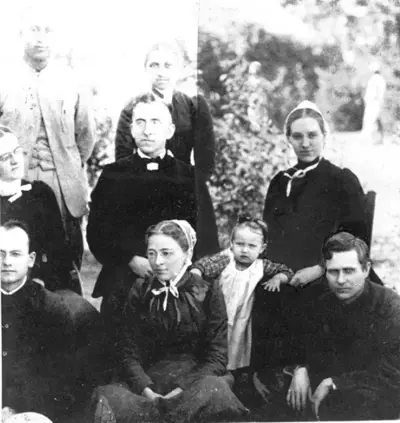
The Mennonites are members of certain Christian groups belonging to the church communities of Anabaptist denominations named after Menno Simons (1496–1561) of Friesland. Through his writings, Simons articulated and formalized the teachings of earlier Swiss founders, with the early teachings of the Mennonites founded on the belief in both the mission and ministry of Jesus, which the original Anabaptist followers held with great conviction, despite persecution by various Roman Catholic and Protestant states. An early set of Mennonite beliefs was codified in the Dordrecht Confession of Faith in 1632, but the various groups do not hold to a common confession or creed.
