Eugene IV Quotes
We order and command all and each of the faithful of each sex that, within the space of fifteen days of the publication of these letters in the place where they live, that they restore to their pristine liberty all and each person of either sex who were once residents of said Canary Islands ... who have been made subject to slavery (servituti subicere). These people are to be totally and perpetually free and are to be let go without the exaction or reception of any money
In this case, the Pope was obeyed on the issue of slavery. However, Papal injunctions against slavery have not always had the desired effect. See {617632}
Eugene IV 1388-1447, Roman Catholic Pope, Papal Bull, January 13, 1435
Sourced by: Eigen's Political and Historical Quotations

The Catholic Papacy was very ambivalent regarding the morality of slavery. Callistus, in effect authorized the morality of enslaving “infidels.” In the past this was a reaction to the Muslim ethic of banning slavery of Muslims but allowing it for “infidels.” This bull has been used to defend slavery ever since despite the fact that there are several other (before and after) Papal pronouncements condemning slavery. See {617550} , {617880} , {617632}

One might think that this remarkable pronouncement would have put an end to Catholic participation and support of slavery. However, in an exercise of theological hair splitting, the Southern Catholic Bishops of the United States took the position that In Supremo outlawed Catholic participation and support of slave trading but not the institution of slavery itself. See {617544} for their official position to the United States Government.


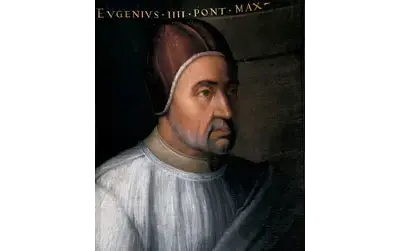
Pope Eugene IV, born Gabriele Condulmer, was head of the Catholic Church and ruler of the Papal States from 3 March 1431 to his death. Condulmer was a Venetian, and a nephew of Pope Gregory XII. In 1431, he was elected pope. His tenure was marked by conflict first with the Colonnas, relatives of his predecessor Martin V, and later with the Conciliar movement. In 1434, due to a complaint by Fernando Calvetos, bishop of the Canary Islands, Eugene IV issued the bull "Creator Omnium", rescinding any recognition of Portugal's right to conquer those islands, still pagan. He excommunicated anyone who enslaved newly converted Christians, the penalty to stand until the captives were restored to their liberty and possessions. In 1443 Eugene decided to take a neutral position on territorial disputes between Portugal and Castile regarding rights claimed along the coast of Africa.
