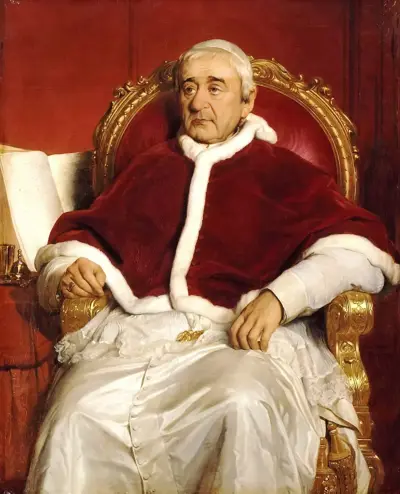
Gregory XVI Quotes
We, by apostolic authority, warn and strongly exhort in the Lord faithful Christians of every condition that no one in the future dare bother unjustly, despoil of their possessions, or reduce to slavery Indians, Blacks or other such peoples….There were to be found subsequently among the faithful some who, shamefully blinded by the desire of sordid gain, in lonely and distant countries did not hesitate to reduce to slavery (in servitutem redigere) Indians, Blacks and other unfortunate peoples, or else, by instituting or expanding the trade in those who had been made slaves by others, aided the crime of others. Certainly many Roman Pontiffs of glorious memory, Our Predecessors, did not fail, according to the duties of their office, to blame severely this way of acting as dangerous for the spiritual welfare of those who did such things and a shame to the Christian name …. We prohibit and strictly forbid any Ecclesiastic or lay person from presuming to defend as permissible this trade in Blacks under no matter what pretext or excuse, or from publishing or teaching in any manner whatsoever, in public or privately, opinions contrary to what We have set forth
One might think that this remarkable pronouncement would have put an end to Catholic participation and support of slavery. However, in an exercise of theological hair splitting, the Southern Catholic Bishops of the United States took the position that In Supremo outlawed Catholic participation and support of slave trading but not the institution of slavery itself. See {617544} for their official position to the United States Government.
Gregory XVI, 1765-1846, Roman Catholic Pope, In Supremo, December 3, 1839
Sourced by: Eigen's Political and Historical Quotations
The Catholic Papacy was very ambivalent regarding the morality of slavery. Callistus, in effect authorized the morality of enslaving “infidels.” In the past this was a reaction to the Muslim ethic of banning slavery of Muslims but allowing it for “infidels.” This bull has been used to defend slavery ever since despite the fact that there are several other (before and after) Papal pronouncements condemning slavery. See {617550} , {617880} , {617632}
In Supremo {617632} condemning slavery
In this case, the Pope was obeyed on the issue of slavery. However, Papal injunctions against slavery have not always had the desired effect. See {617632}
While this apostolic letter condemned the slave trade, it fell short of clearly implicating the entire practice of slavery. It is clear that the Catholic Church at this time was reluctant to abandon its earlier teaching which approved of “just title” slavery. This distinction approved of “slavery” in circumstances in which the person was deprived of their liberty justly. Specific examples in the past have included slaves captured in war, persons condemned to slavery for a crime, and those who sold themselves into slavery.
The “enemy of the human race” is the Devil, Note that the Pope labels as “allies” of the Devil those who advocate and participate in slavery. Slavery was not only immoral, but the Devil was behind it all. The fact that slavery persisted on a massive scale by Catholic countries illustrates that while the Pope was a powerful leaders and figure, even he could not influence all the “sinners.”
The Roman Catholic Church in America had a very difficult problem with slavery. Catholics were themselves a minoirty, hated and distrusted by many Protestants. In most of the country, the distrusr was based on their large immigrant population, but in the South Catholic theology was hated and the Vatican and Pope were particular targets. The Catholic Clergy generally did not want to take sides in the most contentious issue in America since its inception. The Southern Catholic Clergy did not have that option as in the South, anyone who was not a supporter of slavery was an "enemy of the community and subject to all kinds of violence." Some Southern priests were willing to take the personal risk but did not want to put their followers at risk. In a strange consequence, Catholics--especially Irish Catholics--fought on both sides of the Civil War and often against each other. While it was not an exemplary moral behavior for the Church, there were difficult pressures on Catholic leaders. Further, most of the lowest and most difficult, undesirable jobs were filled by Catholics and most Catholic laymen so and end to slavery as the start of pitting the Catholics against the Blacks. So there was not a groundswell for abolition in most Catholic parishes even in the North.
This title of his essay shocked his fellow politicians and may churches that a Congressman would attack churches. Few abolitionists were that outspoken over the disgraceful role that most American Churches had in refraining to oppose slavery. At the time, most Protestant, Roman Catholic, and Jewish clerics either supported slavery or were reluctant to publicly criticize slavery. At the same time the Quakers and many other congregations and clergymen were among the most outspoken and fervent abolitionists. They were very much in the minority,
The king was making his judgment that the English whites did not have the “gut” to kill the number of people and perpetuate the other cruelties to forcibly convert Black Africans to Christianity, and even if they did, it would be inconsistent with the moral tenets of the religion. He was not familiar with the Reformation persecutions of previous generations, nor did he anticipate the effect of colonialism by which large parts of Africa were culturally and religiously converted.
What is interesting is that when he cites the dreadful facts about American slavery, he never points out that the American slave traders rarely raided the villages and captured the slaves themselves. Most often this was done my Khamenei’s Muslim brethren slave traders who dominated the slave trade in Africa. Nor does he point out what after realizing the evil that Americans perpetrated with slavery, we ended it in the 1860s. Saudi Arabia, the central nation of Islam, did not make slavery illegal until 100 years later, and even today, there are many Saudi’s who get caught practicing slavery with household servants and forms of indentured servitude. And while Christians and the Bible tolerated slavery, the Koran and the Prophet never once condemn the practice of slavery. Democracy at any point in time is not always morally right, but it is a process by which under pressure from the people it improves over time because the people can change it and do.
At the beginning of our nation, before there was a Constitution, the state of Virginia prohibited clergy from serving in the state legislature.
- Born: September 18, 1765
- Died: June 1, 1846
- Nationality:
- Profession:
Pope Gregory XVI was head of the Catholic Church and ruler of the Papal States from 2 February 1831 to his death in 1846. He had adopted the name Mauro upon entering the religious order of the Camaldolese.