Michael Dyson Quotes
Slavery was a faith-based institution. It was supported by the churches and their ministers who provided a religious and moral justification of the institution.
Michael Eric Dyson, Author and Scholar, State of Black America Forum, Washington DC, February 3, 2001
Sourced by: Eigen's Political and Historical Quotations


[This was the first Abolition appeal written by a Black Man. It was published in Boston and despite the fact that it was very critical of whites, was very popular going through two more printings within the next two years.]


The letter was written in the supposed style of a Black after Emancipation and includes most of the ugly false stereotypes of the worst of the racists of the present and the slaveowners of past times. Williams stated that he was not a racist and was trying to make a point about freedom required risk and responsibility. However, the effort was interpreted by many people, Black and white, to be insulting and a put down of African Americans. At the same time, although most of the Tea Party members were not racists, most of the racists in America were supporters of the Tea Party. Those people interpreted the quotation as "telling it like it is" about Blacks who do not want the responsiblities and risks of freedom and are not yet developed sufficiently to be equal citizens in a democracy.


Many historians of higher education to not agree with Wilder’s overall generality. However, it was certainly the case that slavery was a major factor in generating the funds for some early universities in the North, but others were “hotbeds” of abolition from their very inception.

The President often referred to this statement as an example of his wife’s acumen. She had been born to a Southern plantation and inherited the land and the slaves. Her view, and his, were typical of the Southern point of view in early America.

It was indeed the first government that was ever founded on that fallacious principle. In retrospect, it was amazing that more Southerners did not question why no other government in the history of the world based a society on that principle. The Southern hubris was a great failing for them.

Nott, a Southerner who owned slaves, was not only an apologist for slavery as this quotation illustrates, but also wrote on his theories of race. Nott was one of the writers about race that Darwin singled out as being completely wrong in 1871: The Descent of Man.


He was not only an atheist himself, but he was a major opponent of organized religion which he regarded as one or the major initiators and drivers of slavery, segregation and discrimination. For this reason he was critical of Martin Luther King—{583307}. His irreligiosity had always prevented his gaining much support from his fellow African Americans even though a great writer like H. L. Menken considered Schuyler, "the best writer in America".


He was also himself a ship owner in the slave trade and he was the brother of the leading Rhode Island abolitionist, Moses Brown. See {585793}. Brown became the first American, prosecuted in federal court for illegal slave trading –-- a prosecution brought, in part, by his own brother. He was, however, acquitted.

In early New England the General Court served as both a legislature and a judiciary before separation of powers was introduced. 5 years later the Court banned importing African slaves at all. While slavery was not common in Rhode Island, the laws was not seriously enforced on those who would defy them. It does represent a public anti-slavery sentiment that existed in Early America. It would take 200 years for Rhode Island to finally eliminate all forms of slavery.

In the original Constitution the apportionment of members of the House of Representatives was based on the white population plus After his Presidency, Adams served in the House of Representatives for many years and was thus active in politics.


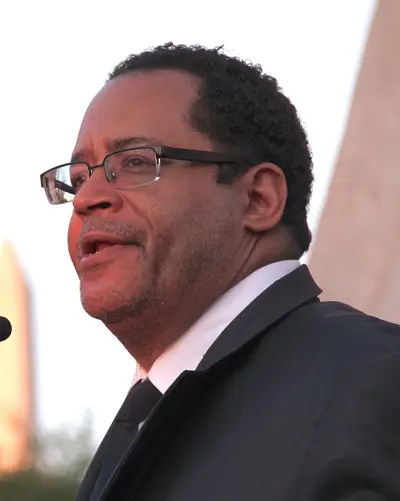
Michael Eric Dyson is an American academic, author, and radio host. He is a professor of Sociology at Georgetown University. Described by Michael A. Fletcher as "a Princeton Ph.D. and a child of the streets who takes pains never to separate the two", Dyson has authored or edited 18 books dealing with subjects such as Malcolm X, Martin Luther King, Jr., Marvin Gaye, Nas's debut album Illmatic, Bill Cosby, Tupac Shakur and Hurricane Katrina.
