Roger B. Taney Quotes
Blacks were so far inferior that they had no rights which the white man was bound to respect.
Roger B. Taney, 1777-1864, Chief Justice of the U. S. Supreme Court, U. S. Treasury Secretary, Dred Scott v. Sanford, 1857
Sourced by: Eigen's Political and Historical Quotations

Supreme Court Chief Justice Roger B. Taney, 1777-1864, had written the infamous Dred Scott decision requiring free states to return escaped slaves from the South. This decision widened the gap between North and South and made the Civil War almost inevitable. See {584921}.

Booth was the younger son of a very prominent Northern family of actors. His older brother was considered the greatest American actor, and the rest of the family were abolitionists and vehement Union supporters. They found young John’s views reprehensible.

Johnson was then Vice President.

His solution was not to change the prejudice or improve the opportunity for Blacks but to have complete separation of the races. See {625687}.


It was indeed the first government that was ever founded on that fallacious principle. In retrospect, it was amazing that more Southerners did not question why no other government in the history of the world based a society on that principle. The Southern hubris was a great failing for them.

Grady, a Georgian, prompted himself as a spokesman for the “New South” and while he did no advocate slavery and the brutality that had been inflicted on Southern Negroes, he was a strong white supremacist as this quotation demonstrates. He was only “liberal” compared with the total revanchist racists. However, when in the North he spoke kindly about the Negro. See Quotation 643652.

Perhaps there is no more dramatic quotation illustrating MacArthur’s arrogance where his own views and decisions should obviously prevail regardless of the policies of his superiors and his commander-in-chief. The army had been officially integrated by President Truman, The reality was that the general honestly believed that he had no superiors among the military, that civilians should not control the military, and in any event that the President—Truman—was not fit to be Commander-in-Chief.


Incredibly enough, after the Civil War and emancipation, most Virginia leaders opposed any form of rights for Blacks with one of the major reasons being that they were ignorant and uneducated. It was actually a crime to teach even a free Black to read.

Forrest went on to be the first National Leader of the Terrorist Organzation.


Phelps was a Copperhead Democrat who was a virulent racist, an enemy of Lincoln and supported McClellan against Lincoln in 1864. His extreme disrespect for the President and his racism was not appreciated in Vermont, and Phelps not only failed to help McClellan but destroyed his own credibility in his home state of Vermont. Phelps had been practicing law in New York City where there was a large Copperhead, racist and anti-Lincoln part of the population there.


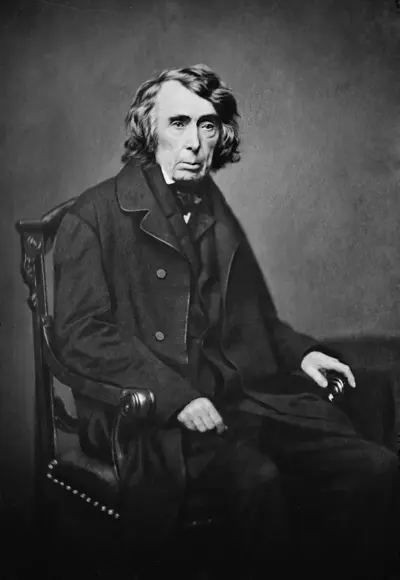
- Born: March 17, 1777
- Died: October 12, 1864
- Nationality: American
- Profession: Judge
Roger Brooke Taney was the fifth Chief Justice of the United States, holding that office from 1836 until his death in 1864. He delivered the majority opinion in Dred Scott v. Sandford (1856), ruling that African Americans could not be considered citizens and that Congress could not prohibit slavery in the territories of the United States. Prior to joining the Supreme Court, Taney served as the United States Attorney General and United States Secretary of the Treasury under President Andrew Jackson.
